
How Can Gulf Oil & Gas Plants Prevent Industrial Pump Failures?
Improve Equipment Reliability for Heavy Industrial Plants in Saudi Arabia
Causes, Proven Prevention Strategies & Best AI-Powered CMMS Software
Table of Contents
Industrial pump failures can be prevented using preventive maintenance, Industrial IoT monitoring, vibration analysis, proper lubrication, and an AI-powered CMMS. These technologies help Gulf oil & gas companies detect issues early, automate maintenance, reduce unplanned downtime, and extend pump life. Fogwing CMMS enables proactive maintenance across refineries, petrochemical plants, offshore platforms, LNG terminals, and gas processing facilities.
Industrial pumps are among the most critical assets in oil and gas operations. Whether transferring crude oil in Saudi Arabia, handling petrochemicals in the UAE, supporting offshore production in Qatar, or managing gas processing in Oman, a single pump failure can interrupt production, increase maintenance costs, delay operations, and create safety and environmental risks.
Unlike many industries, Gulf oil & gas plants operate in extreme conditions where high ambient temperatures, abrasive dust, corrosive coastal environments, continuous 24/7 operations, and demanding production targets accelerate equipment wear. Preventing pump failures requires more than routine inspections; it requires a proactive, data-driven maintenance strategy supported by AI and Industrial IoT.
In This Guide, You'll Learn
- Why industrial pump failures are a growing challenge for Gulf oil & gas plants
- The most common causes of pump failures
- 10 proven strategies to improve pump reliability
- How Industrial IoT and predictive maintenance reduce unexpected failures
- How Fogwing CMMS helps digitize pump maintenance and improve asset performance
What Is an Industrial Pump Failure?
An industrial pump failure occurs when a pump can no longer operate efficiently or safely due to mechanical, electrical, hydraulic, or operational issues. Pump failures can reduce production efficiency, interrupt critical processes, damage connected equipment, and increase maintenance costs.
There are two types of pump failures.
Planned Pump Shutdowns
These are scheduled maintenance activities such as inspections, lubrication, seal replacement, bearing servicing, or performance testing. Planned maintenance helps extend equipment life and reduces the likelihood of unexpected failures.
Unplanned Pump Failures
Unexpected failures occur due to equipment wear, poor maintenance practices, incorrect operating conditions, or undetected faults.
These failures often result in:
- Unplanned production downtime
- Emergency maintenance
- Higher repair costs
- Environmental and safety risks
- Reduced equipment lifespan
- Delayed production schedules
Reducing unplanned pump failures should be a priority for every oil & gas facility because even a single critical pump failure can affect upstream, midstream, or downstream operations.
Why Are Industrial Pump Failures a Growing Challenge for Gulf Oil & Gas Plants?
Industrial pumps support almost every stage of upstream, midstream, and downstream oil & gas operations. They move crude oil, refined fuels, produced water, chemicals, cooling water, seawater, and other critical process fluids that keep production running.
However, Gulf operating conditions create unique maintenance challenges that significantly increase the risk of pump failures.
These include:
- High ambient temperatures that accelerate lubricant degradation
- Airborne sand and dust that contaminate bearings and seals
- Corrosive coastal environments affecting pumps in offshore and marine facilities
- Continuous 24/7 production with limited maintenance windows
- Heavy-duty applications involving abrasive or corrosive process fluids
- Remote desert installations where emergency maintenance is more difficult
These conditions accelerate component wear and reduce the lifespan of bearings, seals, impellers, and rotating assemblies.
In many facilities, the problem extends beyond the pump itself. Reactive maintenance, manual inspection records, poor spare parts visibility, and limited condition monitoring often allow small issues to develop into expensive failures.
As Gulf countries continue investing in Industry 4.0, AI, and digital transformation, maintenance teams are replacing reactive repairs with predictive and condition-based maintenance to improve reliability and maximize production uptime.
What Causes Industrial Pump Failures in Oil & Gas Plants?
Most industrial pump failures are preventable. Understanding their root causes helps maintenance teams improve equipment reliability while reducing unexpected breakdowns. Maintenance and reliability teams use Key Performance Indicators (KPIs) to evaluate equipment performance and identify opportunities for improvement.
| Root Cause | Primary Business Impact | Industry Standard | Recommended Solution |
|---|---|---|---|
|
Reactive Maintenance |
High emergency repair costs, unplanned unit shutdowns |
Increases total maintenance costs by 30–40% |
Implement automated PM schedules via CMMS |
|
Bearing Degradation |
Complete rotating assembly failure, extended downtime |
Monitor against ISO 10816 vibration severity standards |
IIoT continuous vibration & thermal telemetry |
|
Mechanical Seal Leakage |
Hazardous fluid loss, environmental non-compliance |
Align with API 682 piping plan requirements |
Scheduled digital seal plan inspections |
|
Shaft Misalignment |
Accelerated coupling wear, structural fatigue |
Keep within sub-mil tolerances via laser tools |
Precision optical/laser alignment protocols |
|
Hydraulic Cavitation |
Impeller erosion, severe hydraulic efficiency drop |
Verify Net Positive Suction Head (NPSHa vs. NPSHr) |
Suction line redesign & pressure telemetry |
|
Lubricant Breakdown |
Lubricant BreakPremature friction burn-out in extreme heat own |
Accelerated by ambient temperatures >45°C |
Scheduled, viscosity-matched re-greasing |
|
Spare Parts Bottlenecks |
Extended Mean Time to Repair (MTTR) |
Drives inventory holding or emergency freight costs |
CMMS-driven minimum safety stock triggers |
1. Reactive
Many facilities still repair pumps only after they fail. While this approach may appear cost-effective initially, it often results in emergency repairs, longer downtime, expensive replacement parts, and production losses.
Replacing reactive maintenance with preventive maintenance helps identify developing issues before failures occur.
2. Bearing Wear
Bearings are among the most common causes of industrial pump failures. Excessive vibration, poor lubrication, contamination, and continuous operation gradually damage bearings until complete failure occurs.
Routine vibration monitoring and lubrication inspections significantly reduce bearing-related failures.
3. Mechanical Seal Failure
Mechanical seals prevent process fluids from leaking during pump operation. Over time, heat, pressure fluctuations, improper installation, or contamination can damage seals.
Seal failures may lead to:
- Product leakage
- Reduced pump efficiency
- Environmental risks
- Increased maintenance costs
Regular seal inspections should be included in every preventive maintenance schedule.
According to Seal FAQs, seal-related repairs account for approximately 60–70% of all centrifugal pump maintenance work, highlighting the importance of regular seal inspections and proactive maintenance
4. Shaft Misalignment
Even minor shaft misalignment increases vibration levels and accelerates wear on bearings, couplings, and seals.
Misalignment commonly occurs after equipment installation, motor replacement, or maintenance work.
Routine laser alignment improves equipment reliability while reducing unnecessary mechanical stress.
5. Cavitation
Cavitation occurs when vapor bubbles form inside the pump due to insufficient suction pressure. As these bubbles collapse, they damage the impeller and internal components.
Common signs include:
- Loud knocking noises
- Increased vibration
- Reduced flow
- Lower efficiency
- Impeller erosion
Proper pump selection, hydraulic analysis, and routine inspections help minimize cavitation.
6. Poor Lubrication
Improper lubrication remains one of the leading causes of premature bearing failures.
Common lubrication issues include:
- Over-lubrication
- Under-lubrication
- Incorrect lubricant selection
- Contaminated grease
- Missed lubrication schedules
In Gulf operating environments, high ambient temperatures make lubrication management even more critical.
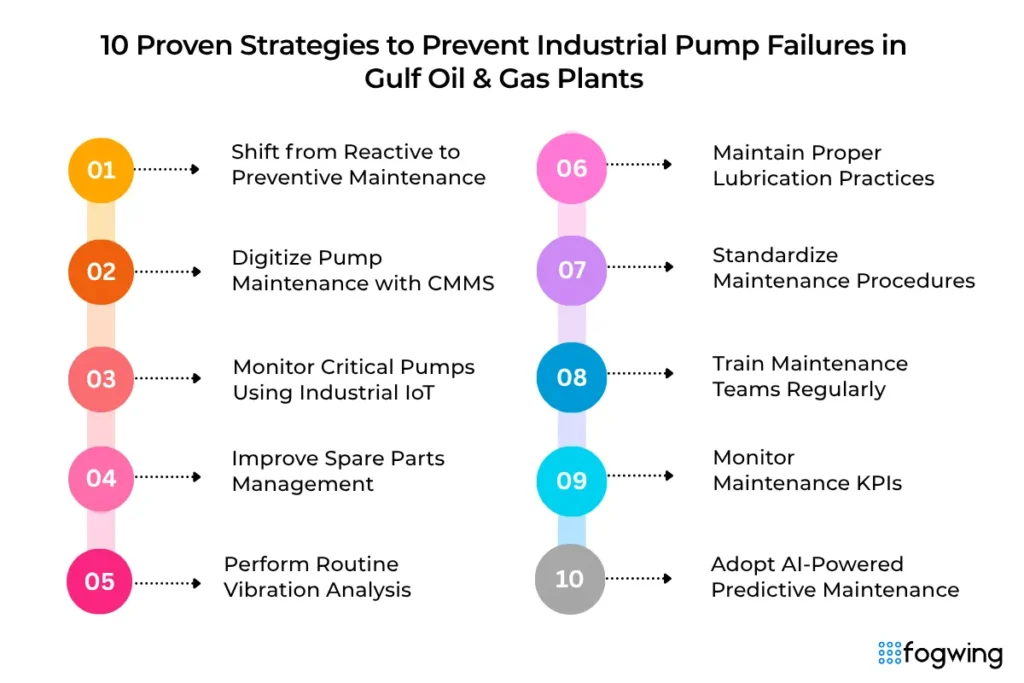
10 Proven Strategies to Prevent Industrial Pump Failures in Gulf Oil & Gas Plants
Preventing industrial pump failures requires more than fixing equipment after it breaks down. Modern oil & gas companies are shifting towards proactive, data-driven maintenance strategies that improve equipment reliability while reducing maintenance costs and production downtime.
The following best practices help maintenance teams extend pump life, reduce unexpected failures, and improve operational efficiency.
1. Shift from Reactive to Preventive Maintenance
Reactive maintenance is one of the biggest contributors to unexpected pump failures. Waiting until a pump stops working often results in emergency repairs, production delays, higher maintenance costs, and increased safety risks.
Instead, schedule preventive maintenance based on:
- Operating hours
- Manufacturer recommendations
- Asset criticality
- Production cycles
- Historical failure trends
Benefits include:
- Fewer unexpected breakdowns
- Lower maintenance costs
- Longer pump lifespan
- Improved equipment availability
- Better maintenance planning
Using an AI-powered CMMS like Fogwing CMMS automates preventive maintenance schedules and ensures maintenance tasks are completed on time.
2. Digitize Pump Maintenance with a CMMS
Paper records and spreadsheets make it difficult to manage maintenance across hundreds of rotating assets.
A modern Computerized Maintenance Management System (CMMS) centralizes maintenance operations and provides complete visibility into asset health.
With a CMMS, maintenance teams can:
- Schedule preventive maintenance
- Generate digital work orders
- Track maintenance history
- Monitor maintenance KPIs
- Manage spare parts inventory
- Maintain digital inspection records
- Improve maintenance compliance
Digitizing maintenance reduces manual errors and helps maintenance teams respond faster to developing equipment issues.
3. Monitor Critical Pumps Using Industrial IoT
Industrial pumps rarely fail without warning.
Parameters such as vibration, temperature, pressure, flow rate, and motor current often change before a breakdown occurs.
Industrial IoT sensors continuously monitor these conditions and provide real-time alerts when abnormal behaviour is detected.
Common parameters to monitor include:
- Bearing temperature
- Pump vibration
- Motor current
- Discharge pressure
- Flow rate
- Runtime hours
- Energy consumption
Real-time monitoring enables maintenance teams to take corrective action before failures impact production.
4. Improve Spare Parts Management
Maintenance delays often occur because replacement parts are unavailable when equipment fails.
Critical spare parts should include:
- Bearings
- Mechanical seals
- Couplings
- Impellers
- Gaskets
- Shafts
- Lubricants
Best practices include:
- Maintain minimum stock levels
- Link spare parts to specific assets
- Track inventory digitally
- Set automatic low-stock alerts
- Review obsolete inventory regularly
An integrated CMMS helps maintenance teams ensure that critical parts are available when needed.
5. Perform Routine Vibration Analysis
Vibration is one of the earliest indicators of pump deterioration.
Routine vibration monitoring helps identify:
- Bearing wear
- Shaft misalignment
- Imbalance
- Loose components
- Cavitation
Detecting these issues early allows maintenance teams to schedule repairs during planned shutdowns instead of reacting to unexpected failures.
6. Maintain Proper Lubrication Practices
Lubrication is essential for extending the life of bearings and rotating equipment.
Maintenance teams should:
- Use manufacturer-recommended lubricants
- Follow lubrication schedules
- Prevent contamination
- Avoid over-lubrication
- Monitor lubricant condition
Proper lubrication significantly reduces premature bearing failures.
7. Standardize Maintenance Procedures
Different technicians often perform inspections differently, leading to inconsistent maintenance quality.
Digital inspection checklists help standardize procedures across all maintenance teams.
Typical inspection checklists include:
- Pump inspection
- Bearing inspection
- Seal inspection
- Alignment inspection
- Lubrication inspection
- Motor inspection
Standardized maintenance improves consistency while reducing human error.
8. Train Maintenance Teams Regularly
Technology supports maintenance, but skilled technicians prevent failures.
Maintenance personnel should receive ongoing training in:
- Root Cause Analysis (RCA)
- Reliability-Centered Maintenance (RCM)
- Vibration Analysis
- CMMS Best Practices
- Industrial IoT Monitoring
Well-trained teams identify developing problems earlier and perform higher-quality maintenance.
9. Monitor Maintenance KPIs
Maintenance performance should be measured continuously.
Track KPIs such as:
| Metric | Full Form | Operational Focus | Targeted Outcome |
|---|---|---|---|
|
MTBF |
Mean Time Between Failures |
Asset Reliability |
Increase operational uptime between maintenance intervals |
|
MTTR |
Mean Time to Repair |
Team Maintenance Efficiency |
Minimize mean duration of unplanned repair work orders |
|
PMC |
Preventive Maintenance Compliance |
Process Adherence |
Maintain >95% completion rate of scheduled work orders |
|
OEE |
Overall Equipment Effectiveness |
Production Capacity |
Optimize availability, performance rate, and fluid throughput |
Regular KPI reviews help optimize maintenance strategies.
10. Adopt AI-Powered Predictive Maintenance
Predictive maintenance combines Industrial IoT, historical maintenance data, and AI to identify failures before they occur.
Instead of servicing equipment at fixed intervals, maintenance activities are triggered based on actual equipment condition.
Benefits include:
- Early fault detection
- Reduced emergency maintenance
- Optimized maintenance schedules
- Extended equipment life
- Lower maintenance costs
- Higher operational reliability
As Gulf oil & gas companies continue their Industry 4.0 journey, predictive maintenance is becoming an essential strategy for improving rotating equipment reliability.
Selecting the Right Maintenance Strategy for Your Plant
While basic maintenance software can digitize work orders, modern oil & gas facilities require much more.
The ideal maintenance platform should combine:
- Preventive maintenance
- Industrial IoT monitoring
- AI-powered maintenance insights
- Asset lifecycle management
- Spare parts management
- Multi-site asset management
- Maintenance dashboards
Choosing an integrated platform helps eliminate data silos while improving maintenance planning and operational visibility.
When Should Oil & Gas Companies Invest in a CMMS?
Many oil & gas companies continue to rely on spreadsheets, paper-based inspections, or disconnected maintenance systems until equipment failures begin affecting production. However, these challenges often indicate that it’s time to adopt a modern CMMS.
Your facility may benefit from a CMMS if you experience:
- Frequent industrial pump breakdowns
- Increasing emergency maintenance work orders
- Difficulty tracking maintenance history
- Poor visibility into spare parts inventory
- Missed preventive maintenance schedules
- Multiple maintenance teams working across different sites
- Limited visibility into equipment health and maintenance KPIs
An AI-powered CMMS centralizes maintenance operations, automates routine workflows, and provides maintenance teams with the information needed to prevent failures before they disrupt production.
How Fogwing CMMS Helps Gulf Oil & Gas Plants Prevent Industrial Pump Failures
Preventing industrial pump failures requires more than scheduling routine maintenance. Maintenance teams need real-time visibility into equipment health, automated workflows, and actionable insights that enable proactive maintenance decisions.
Fogwing CMMS combines preventive maintenance, Industrial IoT integration, AI-powered maintenance intelligence, and digital asset management within a single platform designed for industrial operations.
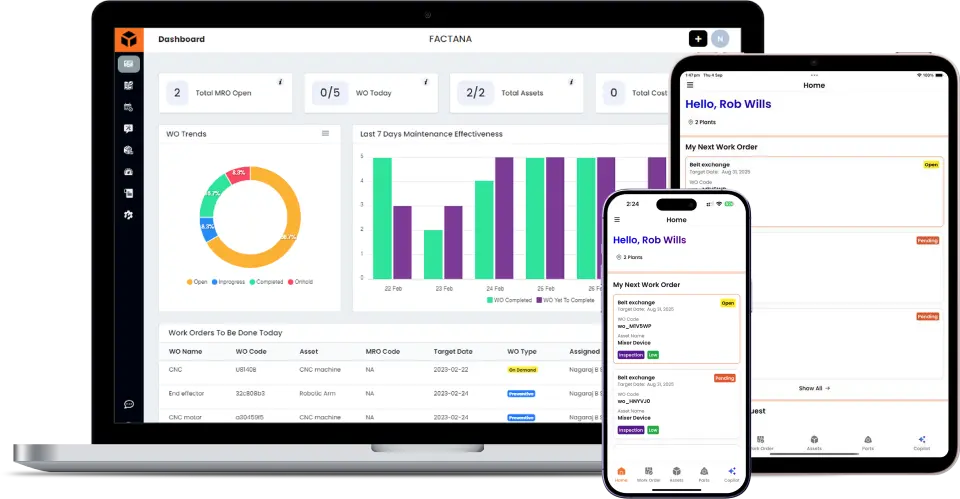
With Fogwing CMMS, maintenance teams can:
- Automatically schedule preventive maintenance based on runtime, calendar intervals, or asset criticality
- Receive real-time alerts from Industrial IoT sensors when vibration, temperature, pressure, or other operating parameters exceed safe limits
- Generate work orders automatically from maintenance schedules or equipment alerts
- Track complete maintenance history to identify recurring pump failures and improve reliability
- Manage spare parts inventory to reduce repair delays and improve maintenance readiness
- Monitor KPIs such as MTBF, MTTR, preventive maintenance compliance, and asset availability through centralized dashboards
- Enable field technicians to access work orders, inspection checklists, and maintenance records using a mobile CMMS application
Whether operating a refinery in Saudi Arabia, a petrochemical complex in the UAE, an offshore platform in Qatar, or a gas processing facility in Oman, Fogwing CMMS helps organizations shift from reactive maintenance to predictive, data-driven maintenance reducing pump failures, minimizing downtime, and improving overall equipment reliability.

Industrial Pump Failure Prevention Checklist
Before implementing your maintenance improvement strategy, review this checklist.
✔ Perform preventive maintenance on all critical pumps.
✔ Monitor vibration and temperature using Industrial IoT sensors.
✔ Digitize maintenance operations using a CMMS.
✔ Maintain adequate inventory of critical spare parts.
✔ Standardize maintenance procedures using digital inspection checklists.
✔ Track MTBF, MTTR, asset availability, and PM compliance.
✔ Automate preventive maintenance scheduling.
✔ Train maintenance teams regularly.
✔ Review recurring failures through Root Cause Analysis.
✔ Use AI insights to identify high-risk assets before failures occur.
Why Trust This Guide?
This guide is based on proven maintenance methodologies, Industrial IoT best practices, AI-driven maintenance strategies, and practical CMMS implementation experience for industrial asset management. It is tailored for Gulf oil & gas companies operating refineries, petrochemical plants, LNG terminals, offshore platforms, and gas processing facilities where equipment reliability is critical
Conclusion
Industrial pump failures remain one of the leading causes of unplanned downtime across Gulf oil & gas operations. While harsh environmental conditions and continuous production place significant stress on rotating equipment, most failures can be prevented through proactive maintenance practices.
By combining preventive maintenance, Industrial IoT condition monitoring, vibration analysis, standardized inspection procedures, and AI-powered maintenance management, organizations can detect equipment issues earlier, reduce emergency repairs, and extend the lifespan of critical pump assets.
As oil & gas companies across Saudi Arabia, the UAE, Qatar, Oman, and the wider Gulf region continue their digital transformation journey, adopting an AI-powered CMMS like Fogwing CMMS is becoming an essential step toward improving equipment reliability and operational efficiency.
FAQs
1. How can Gulf oil & gas plants prevent industrial pump failures?
Industrial pump failures can be prevented through preventive maintenance, Industrial IoT condition monitoring, vibration analysis, proper lubrication, spare parts management, and AI-powered CMMS software.
2. What is the most common cause of industrial pump failure?
Common causes include bearing wear, seal failure, cavitation, shaft misalignment, poor lubrication, and reactive maintenance practices.
3. How does CMMS software improve pump maintenance?
A CMMS automates preventive maintenance, manages work orders, tracks maintenance history, monitors asset performance, and improves maintenance planning.
4. Why is predictive maintenance important for oil & gas pumps?
Predictive maintenance uses real-time sensor data and AI to identify equipment issues before they become failures, reducing downtime and maintenance costs.
5. Which CMMS software is best for Gulf oil & gas maintenance?
The right CMMS depends on operational requirements. Companies looking for preventive maintenance, Industrial IoT integration, AI-powered insights, and multi-site asset management should evaluate platforms such as Fogwing CMMS that combine maintenance management with real-time industrial intelligence.