
Best Maintenance Management Software for Food Manufacturing
Top Maintenance Management Systems for Food Plants
A detailed breakdown of features, compliance needs, and top CMMS platforms for food plants.
Table of Contents
CMMS software for food manufacturing is becoming essential for dairy plants, beverage factories, frozen food facilities, bakeries, meat processing units, and packaged food manufacturers. Modern food plants need maintenance management systems that support preventive maintenance, hygiene compliance, sanitation tracking, audit readiness, and real-time asset monitoring across production lines.
Everything moves fast, everything must stay spotless, and every second depends on machines running perfectly.
That’s where the real struggle begins. Because most food factories are still juggling maintenance using paper logs, Excel sheets, or a whiteboard that’s already outdated by afternoon. And technicians? They’re firefighting more than maintaining.
Food manufacturers searching for the best CMMS for food manufacturing or the best maintenance software for food processing plants are increasingly moving away from paper logs and spreadsheets. Modern maintenance management software now acts as a complete maintenance tracking and asset maintenance system, helping food factories maintain hygiene, compliance, and uninterrupted production.
This guide is for teams that want to transform daily chaos into predictable, compliant, hygienic, and efficient operations using maintenance management software for food manufacturing, built to match the speed and standards of modern plants.
What does Maintenance Management in Food Manufacturing look like today?
Many food plants still rely on reactive maintenance instead of structured CMMS software for food manufacturing. Without proper maintenance tracking software, teams operate in survival mode, responding to breakdowns instead of preventing them.
One missed lubrication cycle, failed CIP cleaning process, ignored refrigeration fluctuation, or skipped sanitation inspection can stop an entire food production line. In food manufacturing environments, maintenance failures directly affect product quality, HACCP compliance, batch traceability, and food safety audits.
- Did someone clean this machine after last shift?
- Where’s the last repair record?
- Why are we fixing this same conveyor again?
The uncomfortable truth? A lot of things still run in memory. And inside a food processing plant where hygiene, speed, and precision matter, memory is the most unreliable system you can depend on.
Common Maintenance Challenges in Food Manufacturing Plants
Across food manufacturing facilities, maintenance teams face many recurring operational challenges that directly affect production efficiency and compliance.
Some of the most common issues include:
- Missed preventive maintenance schedules
- Incomplete sanitation records
- Refrigeration and cold-storage failures
- Repeated conveyor and packaging equipment breakdowns
- Poor spare-parts visibility
- Missing calibration history
- Delayed work order closure
- Limited maintenance traceability during HACCP or GMP audits
These challenges often result from manual maintenance processes rather than the equipment itself. Digital maintenance management software like Fogwing CMMS helps manufacturers standardize maintenance workflows, improve technician accountability, and maintain complete asset history for every production line.
Why Food Manufacturing Needs Specialized Maintenance Software
Food manufacturing maintenance is significantly different from general industrial maintenance because production environments are hygiene-critical, temperature-sensitive, and compliance-driven. Food plants must maintain strict standards under HACCP, FSMA, GMP, BRCGS, ISO 22000, and FSSAI guidelines while ensuring uninterrupted production uptime.
It’s about ensuring hygiene, safety, and compliance at the same time. When something goes wrong, the impact is immediate and the costs are much higher.
1. Hygiene Pressure
Food plants operate under strict cleanliness rules, and even one missed sanitation step can trigger contamination risks, failed audits, or recalls. Hygiene mistakes don’t just slow production they threaten consumer safety and reputation.
2. Temperature-Sensitive Assets
Critical assets like freezers, chillers, and boilers must stay within precise temperature ranges. A minor deviation can ruin batches instantly, disrupt schedules, and increase waste.
3. Faster Wear and Tear
Constant washdowns, chemicals, and humidity cause equipment to degrade much faster than in other industries. Corrosion, electrical issues, and sensor failures become common, shortening asset life significantly.
4. Intense Traceability Demands
Auditors expect proof of every cleaning, service, and inspection. Paper logs collapse under this pressure. Without digital records, audits become stressful and time-consuming.
5. Breakdowns That Stop Everything
Food production lines are tightly linked one small fault can halt the entire shift. There’s no slow mode; operations must run perfectly, making fast and accurate maintenance essential.
Why Maintenance Management Software for Food Manufacturing Is Essential in 2026-2027
Food factories today are more automated, more regulated, and far less forgiving of downtime. With tighter audits and faster production cycles particularly in regulated markets like the UK, EU, Middle East, and APAC paper logs simply can’t keep pace Teams need a system that tracks work as quickly as the plant moves, not hours later.
That’s where a proper maintenance management system makes the difference. It takes the chaos out of daily operations and gives technicians, supervisors, and auditors the clarity they’ve been lacking.
A good Maintenance Management Software helps you:
- Keep every asset on its preventive schedule
- Log sanitation and cleaning cycles digitally
- Track breakdowns instantly
- Record photos and videos of issues
- Manage spare parts without confusion
- Produce clean audit-ready reports
- Prove HACCP, GMP, and FSMA compliance
- Support technicians with real-time updates
When everything is tracked digitally, downtime drops, audits become easier, and production runs with far fewer surprises. For modern food plants, maintenance software isn’t just helpful it’s becoming essential for staying clean, compliant, and efficient.
What Should You Look for in Maintenance Management Software for Food Manufacturing?
Choosing the best maintenance management software for food manufacturing industry isn’t just about picking a tool; it’s about finding something your technicians will actually use. Because if the people on the floor don’t like it or can’t use it easily, the software won’t survive even a week in a fast-moving food environment.
So before anything else, ask yourself: “Will this make life easier for my technicians?”
If the answer is no, move on.
The right maintenance management software should not only include standard CMMS functionality but also support food industry compliance, technician productivity, Industrial IoT integration, and AI-assisted maintenance planning. Platforms such as Fogwing CMMS combine these capabilities into one system, making them well suited for hygiene-critical food manufacturing environments.
- A mobile-first app so technicians can report issues the moment they see them
- Sanitation and cleaning schedule tracking to avoid skipped or forgotten tasks
- Temperature & CCP logging for compliance and batch safety
- Automated preventive maintenance so nothing depends on memory
- Work orders with checklists that keep tasks clear and consistent
- Full digital traceability for audits and accountability
- QR-code asset scanning for quick equipment details
- Inventory and spare-parts tracking so stock is never a mystery
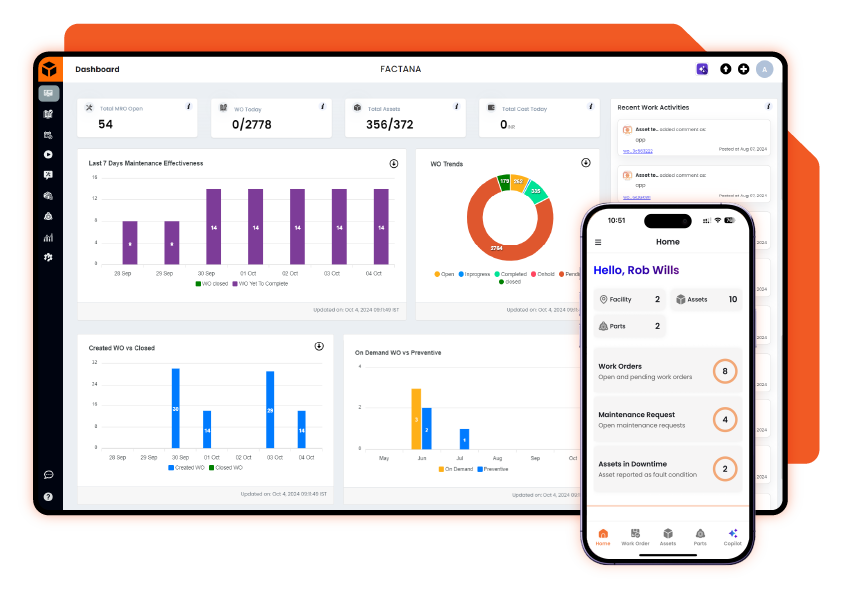
- Real-time dashboards to see exactly what’s happening across the plant
At the end of the day, food factories need three things from their maintenance software:
speed, compliance, and simplicity. Anything that adds complexity doesn’t belong on the production floor.
Why Food Manufacturers Are Moving from Excel Sheets to CMMS Software
Many food manufacturing plants still rely on paper logs, spreadsheets, and manual reporting for maintenance activities. But as audits, sanitation requirements, and production pressures increase, these traditional systems create gaps in preventive scheduling, maintenance traceability, technician communication, and compliance reporting.
That’s why many food manufacturers are moving toward digital CMMS platforms like Fogwing CMMS to streamline maintenance workflows, improve audit readiness, and gain real-time visibility across production assets.
How IoT and AI Are Changing Food Plant Maintenance
Modern food manufacturers are increasingly combining CMMS software with Industrial IoT and Artificial Intelligence.
Connected sensors continuously monitor:
- Refrigeration systems
- Cold storage rooms
- Boilers
- Compressors
- Conveyor motors
- Packaging equipment
When integrated with Fogwing CMMS, abnormal equipment conditions can automatically trigger maintenance alerts, allowing technicians to address problems before failures affect production.
AI-powered maintenance assistants further help maintenance teams identify recurring failures, recommend corrective actions, prioritize work orders, and generate maintenance reports automatically.
The Future of Maintenance Management in the Food Industry
The food industry across India, Europe, the Middle East, and APAC is moving into a smarter, more regulated era and maintenance teams are right at the centre of that transformation. With automation rising and downtime becoming more expensive, the future of food-plant maintenance looks very different from what it was just a few years ago.
Predictive maintenance using sensors
Sensors will continuously track machine health from vibration to temperature to load allowing teams to catch issues long before they turn into breakdowns. Instead of reacting to failures, maintenance will become proactive and prevention-first.
Data-driven cleaning and sanitation cycles
Sanitation will shift from routine schedules to intelligent, data-led triggers. Cleaning will happen when risk indicators rise, not just because it’s “time,” helping plants stay compliant while avoiding unnecessary downtime or resource waste.
Fully digital audits
Paper folders and last-minute scrambling will disappear as every maintenance action, cleaning log, and temperature reading gets recorded digitally. Audits will become smoother, faster, and almost effortless because everything is already organised in one place.
Smart refrigeration monitoring
Cold rooms, chillers, and freezers will be monitored in real time with instant alerts for even minor fluctuations. This ensures products stay safe, batches aren’t lost, and compliance stays intact without constant manual checking.
Automated checklist workflows
Technicians won’t need to memories SOPs or search through files. Digital workflows will guide each task step-by-step, ensuring consistency across shifts and reducing the risk of mistakes in high-pressure environments.
Voice-based reporting for technicians
When hands are full or gloves are on, technicians will simply speak to log issues or complete tasks. Voice reporting will make documentation easier, faster, and far more realistic for busy food-plant floors.
AI copilots supporting decision-making
AI copilots will help food manufacturing teams analyse maintenance history, identify recurring equipment failures, recommend corrective actions, prioritise critical assets, and support technicians during high-pressure production situations.
A quick snapshot of the best CMMS for food manufacturing:
- Fogwing CMMS — Food-industry friendly, mobile-first, IoT-ready, HACCP/SQF support
- LLumin CMMS+ — Strong predictive maintenance & asset life-cycle management for large plants
- TeroTAM — Flexible CMMS with good checklists, audits, and hygiene/compliance workflows
- Fiix CMMS — Modern, integration-friendly CMMS trusted by many food manufacturers
- Fabrico — Simple and clean interface ideal for small/mid food processing units
Now let’s look at each one in more detail.
Top 5 Best Maintenance Management Software for Food Manufacturing
1. Fogwing CMMS Software
Fogwing CMMS is one of the leading CMMS software platforms for food manufacturing industries, helping food plants digitise preventive maintenance, sanitation management, audit compliance, temperature monitoring, and asset reliability through a mobile-first and IoT-enabled platform.
The platform is widely used by manufacturers across India, the Middle East, Europe, the UK, and APAC to manage hygiene-critical maintenance operations in dairy plants, beverage factories, bakeries, frozen food processing units, cold storage facilities, and packaged food production lines.
Why Fogwing CMMS Stands Out
Built for hygiene-sensitive and fast-moving food manufacturing environments
Supports HACCP, GMP, FSMA, SQF, FSSAI, and ISO 22000 compliance workflows
Helps reduce downtime across packaging lines, conveyors, chillers, and processing equipment
Enables mobile maintenance reporting directly from the production floor
Supports IoT-based monitoring for refrigeration systems and critical production assets
Maintains audit-ready maintenance records with complete digital traceability
Easy for teams transitioning from paper logs or spreadsheets
Combines CMMS, IoT, and AI-driven maintenance intelligence in one platform
Key Features
Asset & Work Order Management
Preventive Maintenance Scheduling
Mobile CMMS App for Real-Time Reporting
IoT-Based Temperature & Equipment Monitoring
Digital Sanitation & Cleaning Tracking
Spare Parts & Inventory Management
QR Code-Based Asset Tracking
AI-Based Maintenance Insights
Best For
Small to mid-sized food manufacturers looking for preventive maintenance software with compliance-ready workflows, digital traceability, and technician-friendly maintenance operations.
2. LLumin CMMS+
LLumin is well-known for its robust asset life-cycle tracking and predictive maintenance capabilities. It suits larger food operations that deal with heavy machinery, packaging automation, and strict compliance expectations.
Why It Works for Food Plants
- Deep focus on asset life cycle costing, predictive insights, and energy monitoring
- Good fit for facilities with complex machinery, conveyors, robotics, or packaging lines
- Helps large export-oriented plants maintain consistency and reliability
Key Features
- Condition-based monitoring
- Strong inventory and procurement tools
- Multi-site management
- Automated compliance & audit reports
Best For
Medium to large food manufacturers looking for long-term cost optimisation and predictive reliability.
3. TeroTAM CMMS
TeroTAM is a flexible CMMS that appeals to food plants needing structured workflows around cleaning, inspections, and quality checks. It’s especially helpful for maintaining hygiene standards in multi-shift operations.
Why Food Teams Choose It
- Excellent for routine inspections, sanitation checklists, and hygiene logs
- Easy to use for teams that don’t have high digital maturity
- Good for bakery, dairy, cold storage, and small packaging operations
Key Features
- Digital checklists for sanitation and safety
- Photo-based reporting
- Work order scheduling
- Vendor and AMC management
Best For
Small to mid-sized food factories with repetitive cleaning and compliance-heavy workflows.
4. Fiix CMMS
Fiix is trusted globally by food and beverage producers for its clean interface, integration flexibility, and analytics. It supports both small teams and large multi-site operations.
Why Food Manufacturers Like It
- Modern UI — easy for technicians to adopt
- Integrates well with IoT sensors, PLC data, and analytics platforms
- Good for export-focused plants with strict traceability needs
Key Features
- Custom dashboards
- API and integrations
- Mobile maintenance
- Asset tracking and preventive scheduling
Best For
Mid-sized food processors and beverage manufacturers wanting a modern, integration-ready system.
5. Fabrico
Fabrico offers a lightweight but effective maintenance platform that suits smaller food units needing basic work order and asset tracking without heavy complexity.
Why It’s Popular in Smaller Food Plants
- Simple interface ideal for teams switching from paper logs
- Good for small-scale production, micro food factories, bakeries, and local processors
- Affordable and easy to deploy
Key Features
- Work order management
- Asset tracking
- Maintenance calendars
- Basic analytics and reporting
Best For
Small to mid-scale food manufacturers that want simplicity and fast onboarding.
Among the best CMMS software options for food manufacturing, Fogwing CMMS is frequently evaluated as a leading maintenance management solution for hygiene-critical production environments. Its preventive maintenance automation, sanitation tracking, and mobile workflows align closely with what food manufacturers look for when selecting the best maintenance software for food processing plants — especially where compliance, traceability, and uptime are essential.
Final Thoughts
Food manufacturing is already demanding strict hygiene, fast production, and zero-error quality. Maintenance shouldn’t be added to that pressure.
Choosing the right CMMS is no longer a nice upgrade; it’s essential for staying compliant, reliable, and competitive. Plants that digitise their maintenance see fewer breakdowns, cleaner audits, and smoother operations across every shift.
In regions like India, the UK, Europe, the Middle East, and APAC where every minute and every batch matters smart maintenance becomes the competitive edge
FAQs
1. What is maintenance management software for food manufacturing?
It’s a digital system that helps food plants manage equipment maintenance, sanitation, and compliance using work orders, preventive schedules, and audit-ready records instead of paper logs.
2. What is the best CMMS software for food manufacturing plants?
The best CMMS software for food manufacturing depends on plant size and compliance needs. Popular options include Fogwing CMMS, LLumin CMMS+, TeroTAM, Fiix CMMS, and Fabrico.
3. What features should food manufacturers look for in maintenance management software?
Mobile access, preventive maintenance, sanitation tracking, temperature logging, digital audit trails, and simple technician-friendly workflows.
4. Is maintenance management software useful for small food factories?
Yes. Even small dairies, bakeries, and processors benefit from fewer breakdowns, better traceability, and easier compliance with minimal setup.