
How to Fix Failing Preventive Maintenance Programs in Philippine Manufacturing Plants
Why Preventive Maintenance Programs Fail in Philippine Manufacturing
Common Causes, Proven Solutions & Best Practices for Reliable Manufacturing Operations
Table of Contents
A production line unexpectedly stops because a critical machine breaks down. Customer deliveries are delayed, maintenance costs increase, and technicians discover that the equipment was scheduled for preventive maintenance , but the inspection was missed. This situation is common in many Philippine manufacturing plants, where preventive maintenance programs exist but fail to prevent unexpected equipment breakdowns.
Preventive maintenance programs often fail because of reactive maintenance practices, missed maintenance schedules, manual recordkeeping, poor spare parts management, limited visibility into equipment health, and inconsistent maintenance execution. Manufacturers can address these challenges by standardizing maintenance procedures, automating preventive maintenance with an AI-powered Computerized Maintenance Management System like Fogwing CMMS, monitoring equipment using Industrial IoT, and tracking maintenance KPIs to improve asset reliability and reduce downtime.
As Philippine manufacturers continue investing in Industry 4.0 and digital transformation, maintenance is evolving from paper-based processes to intelligent, data-driven operations. Organizations that combine preventive maintenance with real-time monitoring and digital maintenance management are better positioned to improve equipment reliability, lower operating costs, and maintain consistent production performance.
In This Guide, You'll Learn
- Why preventive maintenance programs fail
- The warning signs of an ineffective maintenance strategy
- The differences between reactive, preventive, and predictive maintenance
- Eight common maintenance challenges and how to solve them
- A practical 90-day roadmap for improving maintenance performance
- How AI-powered CMMS software helps manufacturers digitize maintenance operations
What Is a Preventive Maintenance Program?
A preventive maintenance (PM) program is a planned maintenance strategy that schedules inspections, servicing, lubrication, calibration, cleaning, and component replacement before equipment failures occur. Instead of waiting for machines to break down, maintenance activities are performed at predefined intervals based on operating hours, calendar schedules, production cycles, or manufacturer recommendations.
The objective is simple: keep equipment operating reliably while minimizing unexpected downtime.
An effective preventive maintenance program helps manufacturers:
- Reduce unexpected equipment failures
- Improve equipment availability
- Extend asset lifespan
- Lower maintenance costs
- Improve workplace safety
- Increase production efficiency
- Reduce emergency maintenance work
However, preventive maintenance is only effective when schedules are consistently followed, maintenance activities are documented, and equipment performance is continuously monitored.

Preventive Maintenance vs Predictive Maintenance vs Reactive Maintenance
Many organizations use these maintenance terms interchangeably, but they represent different maintenance strategies with varying levels of efficiency and operational impact.
| Maintenance Strategy | Reactive Maintenance | Preventive Maintenance | Predictive Maintenance |
|---|---|---|---|
|
Maintenance Trigger |
Equipment failure |
]Planned schedule |
Real-time equipment condition |
|
Downtime |
Highest |
Moderate |
Lowest |
|
Maintenance Cost |
Highest |
Lower |
Optimized |
|
Planning |
None |
Calendar or runtime-based |
Data and AI-driven |
|
Equipment Reliability |
Low |
Good |
Excellent |
|
Technology |
None |
CMMS (optional) |
CMMS + Industrial IoT + AI |
|
Best For |
Non-critical assets |
Routine maintenance |
Critical production assets |
Reactive vs Preventive vs Predictive Maintenance: Which Strategy Is Best?
Reactive maintenance may be acceptable for low-value or non-critical equipment where failures have minimal business impact. However, relying on this approach for production-critical assets often leads to costly downtime, emergency repairs, and shorter equipment life.
Preventive maintenance significantly improves reliability by servicing equipment before failures occur. However, because maintenance is performed on fixed schedules, some components may be replaced earlier than necessary while others may fail unexpectedly between inspections.
Predictive maintenance builds on preventive maintenance by using real-time condition monitoring to detect equipment issues before they result in failures. Instead of relying solely on fixed maintenance schedules, maintenance activities are planned based on actual asset condition, improving reliability while reducing unnecessary maintenance.
For most Philippine manufacturers, combining preventive maintenance with condition-based monitoring provides the best balance between reliability, maintenance costs, and operational efficiency.
Signs Your Preventive Maintenance Program Is Failing
A preventive maintenance program is only effective if it improves equipment reliability and reduces unplanned downtime. If your facility continues experiencing recurring failures despite scheduled maintenance, it may be time to review your maintenance strategy. Warning signs include:
- Increasing emergency work orders
- Frequent equipment breakdowns despite scheduled maintenance
- Preventive maintenance tasks that are repeatedly overdue
- Rising maintenance costs
- Low technician productivity
- Poor spare parts availability
- Declining equipment reliability
- Limited visibility into maintenance performance
- Repeated failures on the same equipment
- Difficulty tracking maintenance history
Recognizing these warning signs early allows maintenance managers to address operational issues before they affect production performance.
Why Preventive Maintenance Programs Fail in Philippine Manufacturing Plants
Even when preventive maintenance schedules are in place, many Philippine manufacturers continue to experience recurring breakdowns because maintenance planning, execution, and monitoring are inconsistent. Common challenges include:
- Heavy dependence on reactive maintenance
- Manual maintenance records
- Missed preventive maintenance schedules
- Limited equipment visibility
- Poor spare parts planning
- Inconsistent inspections
- Lack of maintenance KPIs
- Limited adoption of predictive maintenance technologies
As manufacturing competition increases across sectors such as food processing, electronics, automotive, plastics, and metal fabrication, these challenges directly affect productivity, profitability, and customer satisfaction.
The Business Cost of a Failing Preventive Maintenance Program
A poorly managed preventive maintenance program impacts production, maintenance, inventory, customer deliveries, and profitability. For example, a failed air compressor can stop multiple production lines, increase overtime costs, and reduce Overall Equipment Effectiveness (OEE).
| Maintenance Challenge | Business Impact |
|---|---|
|
Equipment breakdowns |
Production downtime |
|
Missed PM schedules |
Higher repair costs |
|
Reactive maintenance |
Increased overtime |
|
Manual maintenance records |
Poor planning |
|
Spare parts shortages |
Longer repair times |
|
Limited asset visibility |
Unexpected failures |
NIST estimates that preventable maintenance issues cost manufacturers approximately US$119.1 billion annually, including US$18.1 billion in downtime-related losses.
Eight Common Reasons Preventive Maintenance Programs Fail
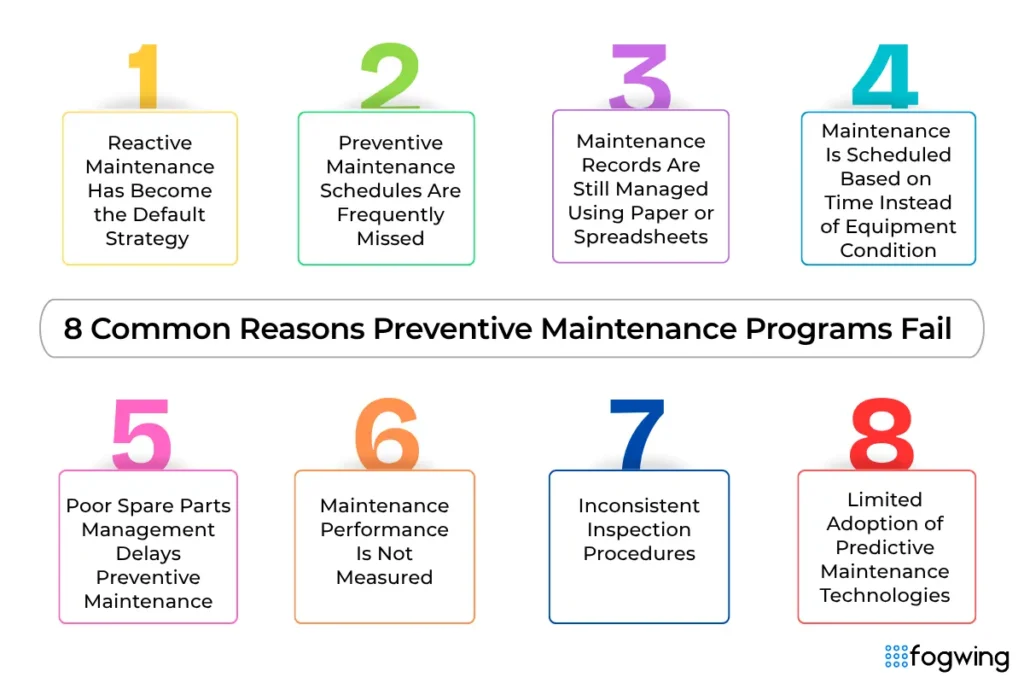
1. Reactive Maintenance Has Become the Default Strategy
Many maintenance departments spend most of their time responding to emergency equipment failures rather than preventing them.
As a result, preventive maintenance tasks are repeatedly postponed while technicians focus on urgent repairs.
This creates a cycle of recurring breakdowns, higher maintenance costs, and reduced equipment reliability.
Breaking this cycle requires management commitment, better maintenance planning, and dedicated time for preventive maintenance activities.
2. Preventive Maintenance Schedules Are Frequently Missed
Creating maintenance schedules is only the first step. Consistently following them is often the real challenge.
Production priorities, changing manufacturing schedules, limited technician availability, and manual planning methods frequently cause preventive maintenance activities to be delayed.
Over time, missed maintenance increases equipment wear and significantly raises the risk of unexpected failures.
Automated scheduling through a CMMS helps ensure preventive maintenance activities are completed on time.
3. Maintenance Records Are Still Managed Using Paper or Spreadsheets
Many manufacturing facilities continue relying on handwritten inspection reports and Excel spreadsheets.
While these tools may be sufficient for smaller operations, they become difficult to manage as equipment inventories grow.
Common problems include:
- Missing maintenance history
- Duplicate work orders
- Lost inspection reports
- Poor maintenance visibility
- Limited reporting capabilities
A centralized digital maintenance system improves documentation, reporting, and maintenance planning while reducing administrative effort.
4. Maintenance Is Scheduled Based on Time Instead of Equipment Condition
Traditional preventive maintenance assumes equipment requires servicing at fixed intervals.
In reality, two identical machines operating under different workloads may wear at very different rates.
Condition-based monitoring allows maintenance teams to schedule work based on actual equipment health rather than fixed maintenance intervals. Instead of replacing components too early or reacting after failures, maintenance is performed only when asset condition indicates it is necessary.
5. Poor Spare Parts Management Delays Preventive Maintenance
Even the most carefully planned preventive maintenance program can fail if technicians do not have the required spare parts when maintenance is scheduled.
Many manufacturing plants in the Philippines struggle to maintain the right inventory levels. Some overstock slow-moving parts, tying up capital, while others frequently run out of critical components needed for scheduled maintenance.
Imagine a packaging machine scheduled for preventive maintenance. During inspection, the technician identifies a worn drive belt that needs replacement. Unfortunately, the replacement belt isn’t available, so maintenance is postponed. A few days later, the belt snaps during production, causing several hours of unplanned downtime
Common spare parts challenges include:
- Stock-outs of critical components
- Manual inventory tracking
- Delayed procurement
- Emergency purchases at higher costs
- Poor visibility into inventory levels
Integrating spare parts management with maintenance planning helps ensure technicians have the right components available before work begins, reducing maintenance delays and unexpected failures.
6. Maintenance Performance Is Not Measured
Many maintenance teams focus on completing work orders without evaluating whether their preventive maintenance program is actually improving equipment reliability.
Without measurable performance indicators, it becomes difficult to identify recurring problems or justify maintenance improvements.
Key questions include:
- Is preventive maintenance reducing equipment failures?
- Which assets require the most maintenance?
- Are maintenance costs increasing or decreasing?
- How often are preventive maintenance tasks completed on time?
Tracking maintenance KPIs helps answer these questions and supports better decision-making.
Some of the most valuable maintenance KPIs include:
| KPI | Why It Matters |
|---|---|
|
MTBF (Mean Time Between Failures) |
Measures equipment reliability |
|
MTTR (Mean Time to Repair) |
Measures maintenance efficiency |
|
Preventive Maintenance Compliance |
Tracks completion of scheduled maintenance |
|
Asset Availability |
Measures equipment uptime |
|
Maintenance Cost per Asset |
Identifies high-cost equipment |
|
Emergency Work Orders |
Indicates reliance on reactive maintenance |
Organizations that regularly review these KPIs can identify trends, prioritize improvements, and optimize maintenance resources more effectively.
7. Inconsistent Inspection Procedures
Inspection quality often varies based on technician experience. Without standardized inspection procedures, critical equipment issues can be missed, leading to inconsistent maintenance, repeated failures, poor documentation, and compliance risks.
Standardized digital inspection checklists help ensure every technician follows the same process, improving maintenance consistency and record accuracy. Common checklists include:
- Motor inspections
- Conveyor inspections
- Bearing inspections
- Lubrication checks
- Electrical system inspections
- Hydraulic system inspections
- Safety inspections
Consistent inspections improve maintenance quality and create reliable records for future analysis.
8. Limited Adoption of Predictive Maintenance Technologies
Traditional preventive maintenance relies on fixed maintenance intervals, regardless of the actual condition of equipment.
Predictive maintenance takes a different approach by continuously monitoring equipment health using Industrial IoT sensors and AI-powered analytics.
Parameters commonly monitored include:
- Vibration
- Bearing temperature
- Motor current
- Pressure
- Flow rate
- Energy consumption
- Operating hours
For example, increasing vibration levels can indicate bearing wear weeks before failure occurs. Maintenance teams can schedule repairs during planned downtime instead of responding to unexpected breakdowns.
As more Philippine manufacturers embrace Industry 4.0, predictive maintenance is becoming an essential strategy for improving equipment reliability while reducing maintenance costs.
How to Fix a Failing Preventive Maintenance Program
Improving preventive maintenance requires more than increasing maintenance frequency. Successful manufacturers focus on building standardized processes supported by technology and continuous performance monitoring.
1. Prioritize Preventive Maintenance
Allocate dedicated maintenance windows and ensure preventive work is completed before emergency repairs begin to dominate technician schedules.
2. Digitize Operations Maintenance
Replace paper records and spreadsheets with a centralized Computerized Maintenance Management System (CMMS) that stores asset history, work orders, maintenance schedules, and inspection reports.
3. Automate Preventive Maintenance Scheduling
Automated scheduling ensures maintenance activities are generated based on:
- Calendar intervals
- Operating hours
- Meter readings
- Production cycles
- Asset criticality
Automation reduces administrative effort while improving maintenance compliance.
4. Improve Spare Parts Planning
Maintain minimum inventory levels for critical components, link spare parts to equipment, and automate low-stock alerts to avoid maintenance delays.
5. Monitor Equipment Health
Implement real-time condition monitoring for critical assets to detect early signs of equipment deterioration and support proactive maintenance planning.
6. Maintenance Procedures Standardize
Create digital inspection checklists and standard operating procedures so maintenance activities are performed consistently across all technicians and production lines.
7. Monitor Maintenance Performance
Review KPIs regularly to identify improvement opportunities and optimize maintenance strategies.
A Practical 90-Day Roadmap to Improve Preventive Maintenance
Improving maintenance doesn’t happen overnight. A phased implementation approach helps organizations build sustainable maintenance processes while minimizing disruption.
Days 1–30: Assess and Standardize
Focus on understanding your current maintenance program.
Key activities:
- Audit preventive maintenance schedules
- Identify critical assets
- Review maintenance history
- Standardize inspection procedures
- Organize spare parts inventory
- Define KPIs such as MTBF, MTTR, and PM Compliance
Expected outcome:
A clear understanding of maintenance gaps and standardized maintenance procedures.
Days 31–60: Digitize Maintenance Operations
Replace manual processes with digital maintenance management.
Key activities:
- Implement a CMMS
- Create digital asset records
- Digitize work orders
- Automate preventive maintenance scheduling
- Introduce digital inspection checklists
- Train maintenance technicians
Expected outcome:
Improved maintenance visibility, better documentation, and fewer missed preventive maintenance tasks.
Days 61–90: Optimize Using Data
Use maintenance data to improve decision-making.
Key activities:
- Review maintenance KPIs weekly
- Integrate Industrial IoT sensors for critical assets
- Analyze recurring equipment failures
- Optimize maintenance intervals
- Review spare parts usage
- Generate maintenance performance dashboards
Expected outcome:
Higher equipment availability, fewer emergency repairs, and improved maintenance efficiency.
When Should Philippine Manufacturers Invest in a CMMS?
Many manufacturers continue using spreadsheets until maintenance complexity begins affecting production.
A CMMS becomes valuable when organizations experience:
- Frequent equipment breakdowns
- Missed preventive maintenance schedules
- Difficulty tracking maintenance history
- Poor spare parts visibility
- Increasing emergency work orders
- Multiple production lines or facilities
- Paper-based inspection processes
- Limited maintenance reporting
A centralized CMMS helps maintenance teams automate scheduling, improve collaboration, and gain complete visibility into maintenance operations.
Why Fogwing CMMS Is a Smart Choice for Philippine Manufacturers
Successfully improving preventive maintenance requires more than creating maintenance schedules. Organizations need a platform that connects assets, maintenance activities, spare parts, inspections, and performance data in one centralized system.
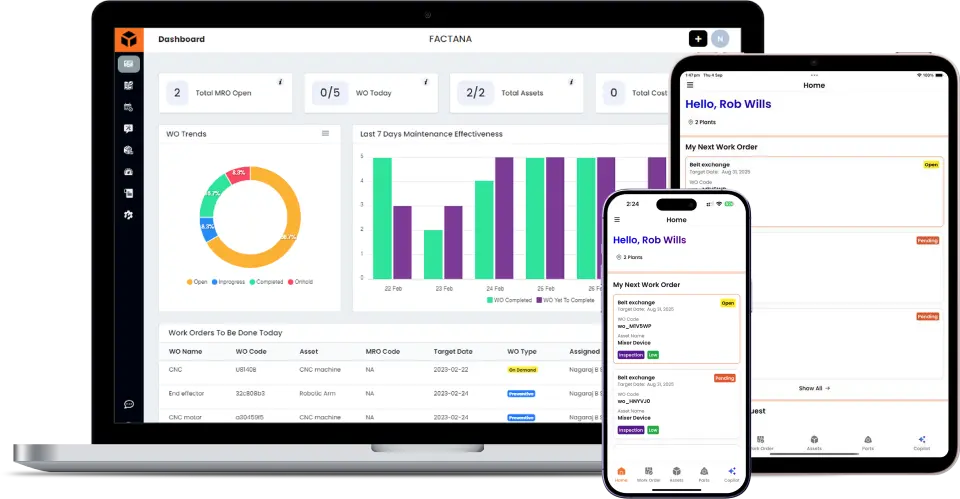
Fogwing CMMS helps manufacturers transition from reactive maintenance to proactive, data-driven maintenance by providing:
- Automated preventive maintenance scheduling
- Digital work order management
- Complete asset maintenance history
- Mobile maintenance capabilities
- Digital inspection checklists
- Spare parts and inventory management
- Real-time maintenance dashboards
- KPI reporting
- Industrial IoT integration
- AI-powered maintenance insights
- Multi-site maintenance management
Whether operating a food processing plant in Laguna, an electronics manufacturing facility in Cavite, an automotive parts factory in Batangas, or a metal fabrication plant in Cebu, manufacturers can use Fogwing CMMS to improve equipment reliability, reduce downtime, and streamline maintenance operations.

Preventive Maintenance Success Checklist
Use the following checklist to evaluate your maintenance program:
✅ Preventive maintenance schedules are completed on time.
✅ Emergency work orders are decreasing.
✅ Maintenance records are stored digitally.
✅ Inspection procedures are standardized.
✅ Critical spare parts are always available.
✅ Maintenance KPIs are reviewed regularly.
✅ Critical assets are monitored using real-time data.
✅ Root Cause Analysis (RCA) is performed for recurring failures.
✅ Maintenance teams receive regular training.
✅ Maintenance strategies are continuously improved using performance data.
Why Trust This Guide?
This guide is based on established preventive maintenance principles, Industry 4.0 best practices, Computerized Maintenance Management System (CMMS) implementation strategies, Industrial IoT monitoring approaches, and real-world manufacturing maintenance workflows. It is intended to help maintenance managers, plant engineers, reliability teams, and manufacturing leaders improve equipment reliability and reduce unplanned downtime through practical, data-driven maintenance strategies.
Conclusion
Preventive maintenance succeeds when organizations combine standardized processes, digital maintenance management, performance measurement, and real-time equipment monitoring. By replacing manual workflows with AI-powered CMMS platforms such as Fogwing CMMS and adopting real-time condition monitoring, Philippine manufacturers can reduce downtime, improve asset reliability, lower maintenance costs, and build more resilient manufacturing operations.
FAQs
1. Why do preventive maintenance programs fail in manufacturing plants?
Preventive maintenance programs typically fail because of reactive maintenance practices, missed maintenance schedules, manual recordkeeping, poor spare parts management, inconsistent inspections, and limited visibility into equipment health.
2. What is the difference between preventive and predictive maintenance?
Preventive maintenance follows scheduled service intervals, while predictive maintenance uses real-time equipment data, Industrial IoT sensors, and analytics to determine when maintenance should be performed based on actual asset condition.
3. How can manufacturers improve preventive maintenance?
Manufacturers can improve preventive maintenance by automating maintenance scheduling, digitizing maintenance records, standardizing inspections, monitoring maintenance KPIs, improving spare parts management, and implementing condition monitoring technologies.
4. When should a manufacturing company invest in a CMMS?
Organizations should consider implementing a CMMS when they experience recurring equipment failures, missed preventive maintenance schedules, difficulty managing maintenance records, increasing emergency repairs, or growing maintenance complexity.
5. How does Fogwing CMMS improve preventive maintenance?
Fogwing CMMS automates preventive maintenance scheduling, digitizes work orders and inspections, manages spare parts inventory, integrates Industrial IoT monitoring, tracks maintenance KPIs, and provides AI-powered insights that help manufacturers improve equipment reliability while reducing downtime.