
How to Reduce Maintenance Costs in Indian Manufacturing Plants
Maintenance Cost Reduction Guide for Indian SME Manufacturing Plants
Reduce costs, improve reliability, Maximize uptime.
Table of Contents
Indian SME manufacturers can reduce maintenance costs by replacing reactive maintenance with preventive maintenance, optimizing spare parts inventory, digitizing maintenance workflows with a Computerized Maintenance Management System (CMMS), and using Industrial IoT to monitor equipment health. These practices help reduce unplanned downtime, extend equipment lifespan, improve maintenance efficiency, and lower overall maintenance expenses without compromising production.
For many small and medium-sized manufacturing companies across India, maintenance costs continue to rise despite investments in equipment and skilled manpower. Whether you’re running an auto component factory in Pune, a textile mill in Coimbatore, a food processing plant in Gujarat, or a precision engineering workshop in Rajkot, unplanned maintenance expenses can quickly reduce profitability and disrupt production schedules.
The solution isn’t reducing maintenance budgets, it’s making maintenance more proactive, data-driven, and efficient. By combining preventive maintenance, optimized spare parts management, Industrial IoT-based condition monitoring, and an AI-powered Computerized Maintenance Management System like Fogwing CMMS, manufacturers can reduce avoidable maintenance expenses, improve equipment reliability, and increase overall production efficiency.
In This Guide, You'll Learn
- Why maintenance costs are increasing in Indian SME manufacturing plants
- The biggest factors contributing to unnecessary maintenance expenses
- 10 proven strategies to reduce maintenance costs without affecting production
- How AI, Industrial IoT, and preventive maintenance improve maintenance efficiency
- How Fogwing CMMS helps manufacturers automate maintenance and control maintenance costs
Why Reducing Maintenance Costs Matters
Maintenance costs extend far beyond repair expenses. Unplanned equipment failures can disrupt production schedules, delay customer deliveries, increase overtime labour, and lead to unnecessary spare parts consumption.
Industry research consistently shows that emergency maintenance is significantly more expensive than planned preventive maintenance, making proactive maintenance one of the most effective ways to improve operational efficiency and control long-term maintenance costs.
According to Frost & Sullivan, Indian manufacturing companies typically allocate around 15–20% of their operating expenditure to maintenance activities. Organizations adopting predictive maintenance practices can reduce overall maintenance costs by up to 20%, highlighting the value of proactive and data-driven maintenance strategies.
Why Are Maintenance Costs Increasing in Indian SME Manufacturing Plants?
Maintenance is no longer just a support function. For SME manufacturers, it directly impacts production output, product quality, delivery commitments, and overall profitability.
Unlike large enterprises, SMEs typically operate with:
- Smaller maintenance teams
- Limited maintenance budgets
- Aging production equipment
- Manual maintenance processes
- Limited visibility into equipment performance
As production demand increases, these challenges become more difficult to manage.
Many manufacturers continue relying on spreadsheets, paper maintenance logs, or disconnected software systems. Without real-time visibility into asset performance, maintenance teams often respond only after equipment has already failed.
This reactive approach leads to:
- Frequent emergency repairs
- Higher labour costs
- Increased machine downtime
- Excessive spare parts purchases
- Lower technician productivity
- Reduced equipment lifespan
The good news is that many of these expenses are avoidable. By implementing structured maintenance processes and a digital maintenance management system like CMMS, SME manufacturers can significantly improve operational efficiency while reducing overall maintenance costs.

What Contributes Most to High Maintenance Costs?
Before reducing maintenance costs, it’s important to understand what causes them. In most manufacturing plants, maintenance expenses are not driven by one major issue but by several recurring operational inefficiencies.
1. Reactive Maintenance
Many manufacturers still repair equipment only after it fails.
Although this approach may appear cost-effective initially, reactive maintenance often results in:
- Emergency repair costs
- Longer production interruptions
- Overtime labour
- Higher spare parts consumption
- Secondary equipment damage
Unexpected failures almost always cost significantly more than planned maintenance activities.
2. Unplanned Machine Downtime
Maintenance costs don’t stop at repair expenses.
Every hour of machine downtime may also result in:
- Lost production
- Missed customer deliveries
- Idle workforce
- Production rescheduling
- Product wastage
- Emergency procurement of spare parts
Reducing downtime is often one of the quickest ways to lower overall maintenance costs.
3. Poor Spare Parts Management
Many SME manufacturers either overstock inventory or struggle to find critical spare parts when equipment fails.
Poor inventory management often leads to:
- Excess capital tied up in inventory
- Duplicate purchases
- Emergency procurement
- Obsolete inventory
- Longer repair times
Maintaining the right spare parts inventory helps reduce both maintenance costs and equipment downtime.
4. Inadequate Preventive Maintenance
Skipping routine maintenance may reduce short-term expenses, but it usually increases long-term costs.
Without preventive maintenance:
- Components wear out faster.
- Equipment reliability decreases.
- Unexpected failures become more frequent.
- Repairs become more expensive.
Preventive maintenance is one of the most cost-effective investments manufacturers can make.
5. Manual Maintenance Management
Paper records and spreadsheets make it difficult to manage maintenance efficiently.
Common challenges include:
- Missed maintenance schedules
- Lost work orders
- Incomplete maintenance history
- Limited asset visibility
These inefficiencies increase administrative work while making maintenance decisions more difficult.
6. Limited Asset Performance Data
Without accurate maintenance data, manufacturers cannot identify:
- High-maintenance assets
- Frequently failing equipment
- Maintenance cost trends
- Root causes of failures
- Opportunities for improvement
Better maintenance decisions require better maintenance data.
Reactive vs Preventive Maintenance: Which Costs Less?
| Reactive Maintenance | Preventive Maintenance |
|---|---|
|
Repairs equipment after failure |
Services equipment before failure occurs |
|
Higher emergency repair costs |
Lower planned maintenance costs |
|
More production downtime |
Less unplanned downtime |
|
Higher labour and overtime expenses |
Better technician utilization |
|
Shorter equipment lifespan |
Longer asset lifespan |
|
Unpredictable maintenance budgets |
Better maintenance cost control |
For most Indian SME manufacturers, shifting from reactive to preventive maintenance is one of the fastest ways to reduce overall maintenance costs while improving production reliability.
10 Proven Strategies to Reduce Maintenance Costs
Reducing maintenance costs isn’t about reducing maintenance activities. It’s about performing the right maintenance at the right time using the right information.
Here are ten practical strategies that Indian SME manufacturers can implement.
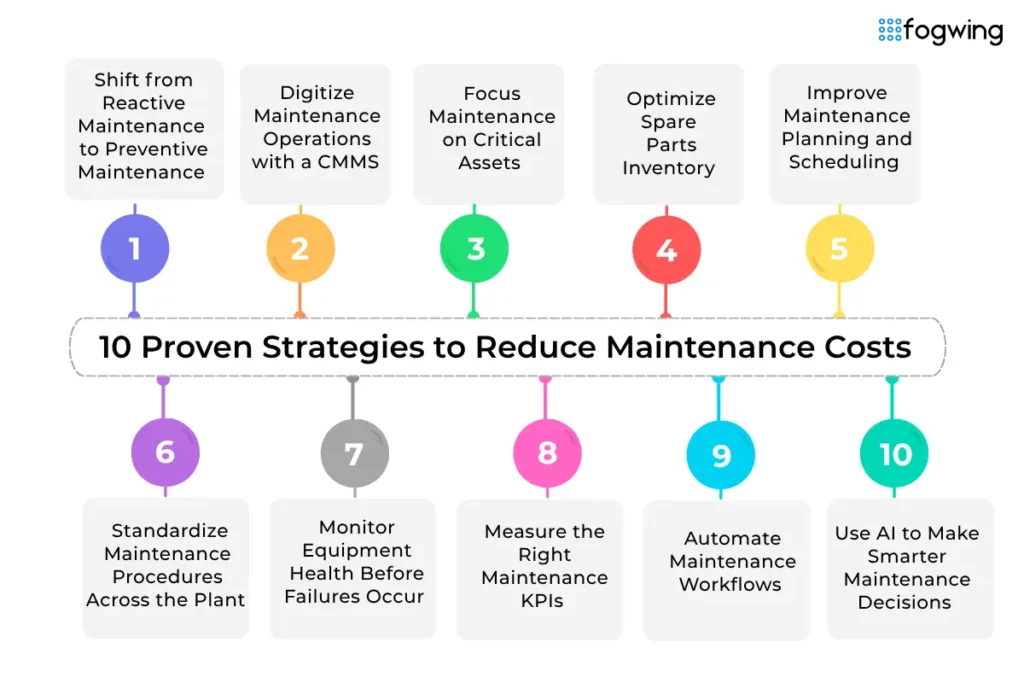
1. Shift from Reactive Maintenance to Preventive Maintenance
Preventive maintenance remains one of the most effective ways to reduce maintenance costs.
Instead of waiting for equipment to fail, maintenance activities should be scheduled based on:
- Operating hours
- Production cycles
- OEM recommendations
- Equipment criticality
- Historical maintenance records
Benefits include:
- Fewer emergency repairs
- Lower maintenance costs
- Longer equipment lifespan
- Higher production availability
- Improved maintenance planning
Manufacturers using preventive maintenance typically spend less on emergency maintenance while improving overall equipment reliability.
2. Digitize Maintenance Operations with a CMMS
Managing maintenance manually becomes increasingly difficult as production grows.
A Computerized Maintenance Management System (CMMS) centralizes maintenance activities by allowing manufacturers to:
- Generate digital work orders
- Track maintenance history
- Monitor maintenance costs
- Manage spare parts inventory
- Measure maintenance KPIs
- Improve technician productivity
Instead of relying on spreadsheets, maintenance teams gain complete visibility into maintenance operations.
3. Focus Maintenance on Critical Assets
Not every machine has the same impact on production.
Manufacturers should identify equipment based on:
- Production dependency
- Downtime impact
- Maintenance costs
- Safety risks
- Failure history
Prioritizing maintenance activities for critical assets helps maximize maintenance budgets while reducing production risk.
4. Optimize Spare Parts Inventory
Spare parts inventory represents a significant portion of maintenance costs.
To improve inventory efficiency:
- Maintain minimum stock levels.
- Remove obsolete inventory.
- Standardize frequently used components.
- Monitor inventory turnover.
- Forecast spare parts demand using maintenance history.
Using FogwingCMMS, maintenance teams can track inventory levels, receive low-stock alerts, and associate spare parts directly with assets and work orders. This improves inventory control while reducing unnecessary procurement costs.
5. Improve Maintenance Planning and Scheduling
One of the biggest reasons maintenance costs increase is poor planning.
When maintenance isn’t scheduled properly, technicians spend more time responding to emergency failures than performing planned work.
Manufacturers should:
- Schedule recurring preventive maintenance.
- Prioritize maintenance by equipment criticality.
- Allocate technicians efficiently.
- Combine similar maintenance tasks.
- Review maintenance schedules regularly.
A structured maintenance plan reduces emergency work, improves technician productivity, and minimizes unnecessary production interruptions.
With Fogwing CMMS, maintenance schedules and recurring work orders can be automated, helping maintenance teams stay ahead of equipment failures while improving maintenance efficiency.
6. Standardize Maintenance Procedures Across the Plant
In many SME manufacturing plants, maintenance quality depends on the experience of individual technicians. As a result, the same maintenance task may be performed differently each time, leading to inconsistent outcomes, recurring failures, and avoidable repair costs.
Creating standardized maintenance procedures ensures that every technician follows the same process, regardless of shift or experience level.
Standardization can include:
- Lubrication schedules
- Equipment-specific preventive maintenance procedures
- Safety inspection checklists
- Standard operating procedures (SOPs) for maintenance activities
Digital checklists further improve consistency by ensuring inspections are completed, documented, and accessible for future reference.
7. Monitor Equipment Health Before Failures Occur
Most equipment failures don’t happen suddenly; they show warning signs days or even weeks in advance.
Changes in vibration, temperature, pressure, current consumption, or operating cycles often indicate developing problems that can be addressed before a breakdown occurs.
Industrial IoT-based condition monitoring allows manufacturers to:
- Detect abnormal equipment behaviour early
- Reduce unexpected breakdowns
- Extend equipment life
- Schedule maintenance proactively
- Lower repair costs
When Industrial IoT monitoring is integrated with Fogwing CMMS, maintenance teams gain real-time visibility into equipment health alongside maintenance history and work orders. This enables faster decision-making and supports a more predictive maintenance approach.
8. Measure the Right Maintenance KPIs
You can’t reduce maintenance costs if you don’t measure them.
Successful manufacturers continuously monitor maintenance performance using key performance indicators (KPIs) that reveal where improvements are needed.
Some of the most important KPIs include:
| KPI | Why It Matters |
|---|---|
|
Maintenance Cost per Asset |
Identifies expensive assets |
|
Mean Time Between Failures (MTBF) |
Measures equipment reliability |
|
Mean Time to Repair (MTTR) |
Measures maintenance efficiency |
|
Preventive Maintenance Compliance |
Ensures scheduled maintenance is completed |
|
Planned vs. Unplanned Maintenance |
Indicates maintenance maturity |
|
Overall Equipment Effectiveness (OEE) |
Measures production efficiency |
Tracking these KPIs over time helps maintenance managers identify trends, justify maintenance investments, and make informed decisions that reduce long-term costs.
With Fogwing CMMS, these KPIs are available through centralized dashboards and reports, making it easier to monitor maintenance performance across assets, departments, or multiple manufacturing locations.
9. Automate Maintenance Workflows
Administrative tasks often consume a surprising amount of maintenance time.
Creating work orders manually, assigning technicians, following up on approvals, and updating spreadsheets all reduce the time available for actual maintenance work.
Workflow automation helps manufacturers:
- Automatically generate preventive maintenance work orders
- Notify technicians instantly
- Track work order progress
- Record maintenance history
- Generate reports automatically
- Improve maintenance accountability
Instead of spending hours managing paperwork, maintenance teams can focus on improving equipment performance.
Fogwing CMMS automates routine maintenance workflows, helping manufacturers reduce administrative overhead while ensuring maintenance activities are completed on schedule.
10. Use AI to Make Smarter Maintenance Decisions
Artificial Intelligence is changing how manufacturers manage maintenance.
Rather than relying solely on fixed maintenance schedules, AI analyzes historical maintenance data, equipment performance, and operating conditions to identify maintenance priorities.
AI-powered maintenance can help manufacturers:
- Predict potential equipment failures
- Identify high-risk assets
- Optimize maintenance schedules
- Reduce unnecessary maintenance activities
- Improve technician productivity
- Increase equipment reliability
For Indian SME manufacturers with limited maintenance resources, AI provides practical insights that help maintenance teams focus on the activities that deliver the greatest operational value.
Fogwing CMMS combines AI-powered maintenance insights with Industrial IoT integration, enabling maintenance teams to prioritize critical assets, improve maintenance planning, and reduce avoidable maintenance costs.
When Should Manufacturers Invest in a CMMS?
Many manufacturers continue using spreadsheets or paper-based maintenance records until maintenance costs become difficult to control. However, implementing a CMMS before maintenance challenges become critical helps organizations prevent costly equipment failures rather than simply responding to them.
You should consider investing in a CMMS if your manufacturing plant experiences any of the following:
- Increasing machine downtime
- Frequent emergency maintenance
- Missed preventive maintenance schedules
- Poor visibility into maintenance costs
- Difficulty tracking spare parts inventory
- Multiple technicians using disconnected maintenance records
- Growing maintenance backlogs
- Limited visibility into asset performance
Modern CMMS software helps manufacturers centralize maintenance planning, automate work orders, improve preventive maintenance compliance, and gain real-time visibility into maintenance operations.
How Fogwing CMMS Helps Indian SME Manufacturers Reduce Maintenance Costs
Implementing preventive maintenance strategies is much easier when supported by the right maintenance management platform.
Fogwing CMMS is designed to help manufacturing companies digitize maintenance operations while improving asset reliability, maintenance efficiency, and operational visibility.
Instead of managing maintenance through spreadsheets or disconnected systems, manufacturers can centralize all maintenance activities within a single platform.
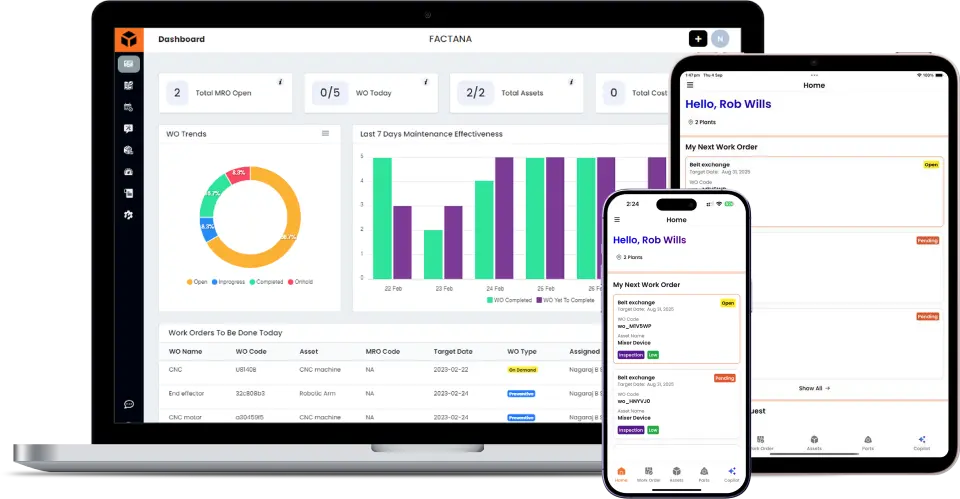
Key capabilities include:
- Preventive maintenance scheduling
- Digital work order management
- AI-powered maintenance insights
- Spare parts and inventory management
- Asset lifecycle management
- QR code and barcode-based asset tracking
- Mobile CMMS for field technicians
- Real-time Industrial IoT integration
- Maintenance dashboards and KPI reporting
- Multi-plant maintenance management
- Workflow automation and approval management
How these capabilities reduce maintenance costs
By bringing maintenance data, asset information, and workflows together, Fogwing CMMS helps manufacturers:
- Reduce emergency repairs through timely preventive maintenance
- Improve technician productivity with digital work orders
- Lower spare parts costs through better inventory visibility
- Reduce machine downtime with real-time equipment monitoring
- Identify maintenance trends using AI-powered analytics
- Extend equipment lifespan through proactive maintenance
- Improve maintenance planning with centralized asset history
- Monitor maintenance KPIs for continuous improvement
For Indian SME manufacturers looking to scale operations while controlling maintenance costs, Fogwing CMMS provides a practical foundation for modern, data-driven maintenance management.

Maintenance Cost Reduction Checklist
Use this checklist to assess your current maintenance strategy:
✔ Replace reactive maintenance with preventive maintenance.
✔ Digitize maintenance planning using a CMMS.
✔ Optimize spare parts inventory and eliminate obsolete stock.
✔ Prioritize maintenance for critical production assets.
✔ Standardize maintenance procedures across teams.
✔ Monitor equipment health using Industrial IoT.
✔ Track KPIs such as MTBF, MTTR, OEE, and maintenance cost per asset.
✔ Automate work orders and preventive maintenance schedules.
✔ Use AI insights to identify maintenance risks earlier.
✔ Review maintenance performance regularly and continuously improve processes.
Common Maintenance Cost Reduction Mistakes to Avoid
Many manufacturers unintentionally increase maintenance costs by focusing only on short-term savings. Some of the most common mistakes include:
- Delaying preventive maintenance to reduce immediate expenses
- Purchasing spare parts without inventory planning
- Managing maintenance through spreadsheets and paper records
- Ignoring early warning signs of equipment failure
- Measuring maintenance performance using too few KPIs
- Treating all production assets with the same maintenance priority
Avoiding these mistakes helps manufacturers improve equipment reliability while maintaining better control over maintenance budgets.
Why Trust This Guide?
This guide is based on established maintenance management principles, preventive maintenance best practices, and the growing adoption of AI, Industrial IoT, and digital maintenance technologies across the manufacturing sector. It is written specifically for Indian SME manufacturers looking to reduce maintenance costs while improving equipment reliability and operational efficiency.
The recommendations presented in this guide align with widely accepted maintenance strategies used across industries such as automotive, food processing, textiles, engineering, chemicals, pharmaceuticals, and discrete manufacturing. They also reflect modern maintenance practices supported by AI-powered CMMS platforms and Industrial IoT technologies that enable more proactive, data-driven maintenance management
It also incorporates practical maintenance workflows commonly adopted by Indian SME manufacturers transitioning from reactive maintenance to preventive and predictive maintenance.
Conclusion
Reducing maintenance costs isn’t about cutting maintenance budgets; it’s about making maintenance more proactive, efficient, and data-driven.
For Indian SME manufacturers, improving maintenance planning, adopting preventive maintenance, optimizing spare parts inventory, and monitoring equipment health can significantly reduce operating costs while improving equipment reliability and production efficiency.
As manufacturing plants continue adopting Industry 4.0 technologies, combining AI, Industrial IoT, and CMMS software is becoming essential for improving asset performance, reducing unplanned downtime, and controlling long-term maintenance costs.
Fogwing CMMS supports this transformation by bringing preventive maintenance, work order management, spare parts control, AI-powered maintenance insights, Industrial IoT integration, and maintenance analytics into a single platform. This enables manufacturers to reduce maintenance costs, improve equipment uptime, and build a more reliable, data-driven maintenance operation.
Whether you’re replacing spreadsheets, modernizing an existing maintenance program, or scaling maintenance across multiple facilities, adopting the right maintenance strategy supported by the right technology can deliver measurable improvements in operational performance, asset reliability, and long-term profitability.
FAQs
1. How can Indian SME manufacturers reduce maintenance costs?
Indian SME manufacturers can reduce maintenance costs by shifting from reactive to preventive maintenance, optimizing spare parts inventory, improving maintenance planning, monitoring equipment health, and using a CMMS like Fogwing CMMS to automate maintenance workflows and improve asset visibility.
2. What is the biggest reason maintenance costs increase?
The most common cause is reactive maintenance. Waiting for equipment to fail often results in emergency repairs, production downtime, higher labour costs, increased spare parts consumption, and reduced equipment lifespan.
3. Does preventive maintenance actually reduce maintenance costs?
Yes. Preventive maintenance identifies potential issues before they become major failures. This reduces repair costs, minimizes downtime, extends equipment life, and improves maintenance efficiency.
4. How does Fogwing CMMS help reduce maintenance costs?
Fogwing CMMS helps manufacturers reduce maintenance costs by automating preventive maintenance schedules, digitizing work orders, managing spare parts inventory, monitoring maintenance KPIs, integrating Industrial IoT data, and providing AI-powered maintenance insights that improve maintenance planning and asset reliability.
5. Is Fogwing CMMS suitable for SME manufacturing companies?
Yes. Fogwing CMMS is designed to support manufacturers of different sizes, including SMEs. Its cloud-based architecture, mobile accessibility, preventive maintenance capabilities, and scalable asset management features make it suitable for growing manufacturing businesses looking to modernize maintenance operations.