In today’s asset-heavy industries, maintenance is no longer a support function; it has evolved into a core driver of operational performance, cost optimization, and risk management. Organizations that treat maintenance strategically consistently outperform those that operate in reactive modes. Two of the most influential approaches shaping this transformation are the Society for Maintenance and Reliability Professionals and Total Productive Maintenance.
While both frameworks aim to improve reliability and reduce downtime, they differ significantly in philosophy, execution, and organizational impact. Understanding these differences is critical for maintenance leaders, especially when designing CMMS driven maintenance ecosystems.
Understanding the Foundations – SMRP vs TPM:
SMRP and TPM serve as foundational pillars for modern maintenance strategies, each with distinct philosophies and execution methods.
What is SMRP?
SMRP provides a globally accepted framework for maintenance and reliability excellence, focusing on structured processes and measurable outcomes. It organizes maintenance practices into five pillars:
- Business & Management
- Work Management
- Equipment Reliability
- Manufacturing Process Reliability
- Organization & Leadership
Each of these pillars ensures that maintenance is not treated in isolation but aligned with business objectives. In practice, SMRP enables organizations to standardize workflows, enforce governance, and track performance using well-defined KPIs such as MTBF, MTTR, and maintenance cost ratios. This makes it particularly valuable for organizations operating across multiple sites or geographies, where consistency is critical.
What is TPM?
TPM, developed by Seiichi Nakajima, takes a fundamentally different approach. It is not just a framework but a culture-driven methodology that integrates maintenance into daily production activities.
TPM emphasizes:
- Eliminating equipment-related losses
- Empowering operators through Autonomous Maintenance
- Driving continuous improvement via Kaizen
- Achieving zero breakdowns, zero defects, and zero accidents
Unlike SMRP, TPM pushes responsibility to the shopfloor. Operators are trained to maintain their own equipment, identify abnormalities early, and collaborate with maintenance teams. This results in higher ownership, faster issue detection, and improved overall equipment effectiveness (OEE).
Core Difference: Management System vs Shopfloor Culture
At a strategic level, the difference between SMRP and TPM becomes very clear:
- SMRP answers: “How efficiently and effectively is maintenance being managed?”
- TPM answers: “Where are the production losses, and how can we eliminate them?”
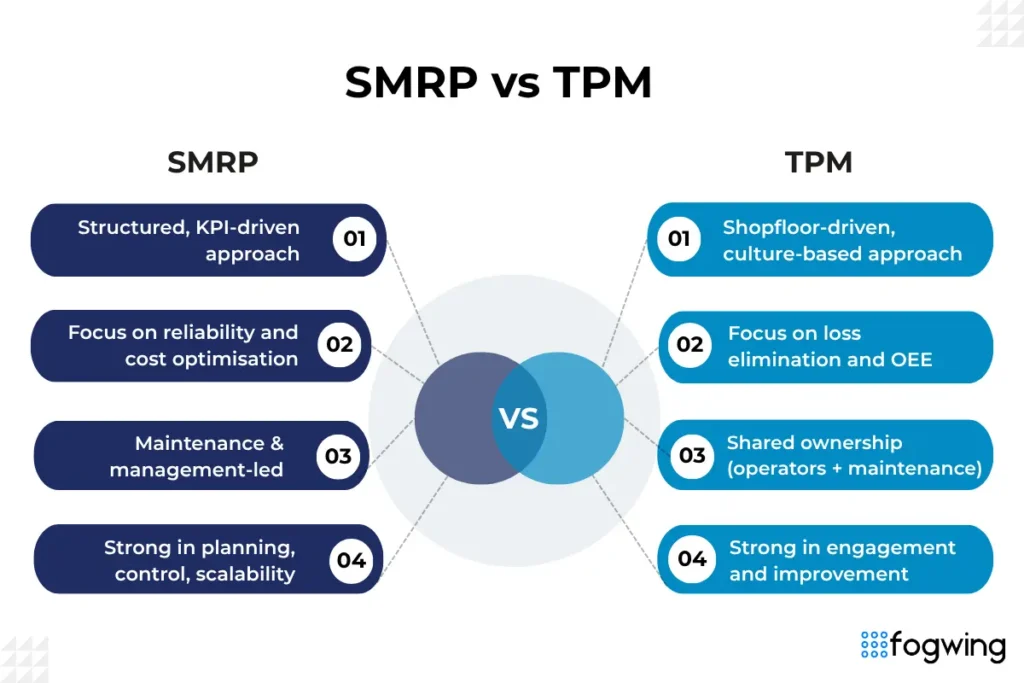
This distinction is crucial. SMRP is about control, measurement, and optimization, while TPM is about engagement, discipline, and continuous improvement at the operational level. A mature maintenance organization needs both perspectives.
Pros and Cons (Maintenance-Centric View)
SMRP – Pros
SMRP’s greatest strength lies in its ability to bring structure and predictability to maintenance operations. Defining standardized processes and KPIs ensures that maintenance activities are measurable and continuously optimized.
- Strong process standardization across plants and regions
- Clear KPI framework (MTBF, MTTR, backlog, cost metrics)
- Enables scalability for multi-site operations
- Improves planning, scheduling, and resource utilization
- Ideal for audit readiness and compliance
In real-world scenarios, this means fewer surprises, better resource allocation, and improved decision-making at the management level.
SMRP – Cons
However, SMRP can sometimes become overly process-heavy, especially in organizations that lack digital tools or cultural alignment.
- Limited focus on operator involvement
- Can become bureaucratic if over-engineered
- May miss micro-level losses like minor stops or speed inefficiencies
- Requires a certain level of organizational maturity to implement effectively
Without proper execution, SMRP risks becoming a reporting exercise rather than a performance improvement system.
TPM – Pros
TPM excels in driving real, visible improvements on the shopfloor. It directly targets production losses and empowers operators to act proactively.
- Drives OEE improvement at the operational level
- Encourages operator ownership and accountability
- Identifies and eliminates hidden losses (Six Big Losses)
- Improves both quality and productivity simultaneously
- Builds a culture of continuous improvement
Organizations implementing TPM often see immediate benefits in terms of reduced downtime, improved product quality, and better equipment utilization.
TPM – Cons
Despite its strengths, TPM is challenging to sustain without strong leadership and organizational discipline.
- No formal global standard comparable to SMRP
- Highly dependent on people and cultural adoption
- Limited focus on financial metrics and cost control
- Can lead to inconsistencies across plants if not governed properly
This makes TPM powerful but sometimes difficult to scale without complementary frameworks.
Industry Adoption: Where Each Fits Best
Industries That Prefer TPM
Industries that rely on continuous production and high equipment utilization tend to favor TPM.
- Automotive manufacturing
- FMCG and food processing
- Electronics manufacturing
- Consumer goods production
In these environments, even small inefficiencies can lead to significant production losses. TPM helps eliminate these losses by focusing on OEE, operator engagement, and real-time problem-solving.
Industries That Prefer SMRP
Industries with complex, high-value assets and strict regulatory requirements typically lean toward SMRP.
- Oil & gas
- Power generation
- Mining & metals
- Large-scale utilities
Here, the priority is not just uptime but also risk management, compliance, and lifecycle cost optimization. SMRP provides the structure needed to manage these complexities effectively.
Hybrid Adoption (Best Practice)
Leading organizations no longer treat TPM and SMRP as mutually exclusive. Instead, they combine both to create a holistic maintenance strategy.
- TPM for shopfloor execution and loss elimination
- SMRP for management control and reliability engineering
This hybrid approach ensures that improvements are both sustainable and scalable.
Regional Adoption Trends
Japan & East Asia
TPM has deep roots in Japan and East Asia, where cultural values such as discipline, teamwork, and continuous improvement align naturally with TPM principles. In many organizations, TPM is not a program but a way of working embedded in daily routines.
North America
North America has been a strong proponent of SMRP, driven by a focus on data-driven decision-making and reliability engineering. Organizations in this region prioritize measurable outcomes, standardized processes, and advanced analytics.
Europe
European industries tend to adopt a balanced approach, integrating both TPM and SMRP. There is a strong emphasis on sustainability, safety, and regulatory compliance, making a hybrid model particularly effective.
India & Emerging Markets
In India and other emerging markets, TPM has gained popularity in manufacturing sectors due to its visible impact on productivity and quality. At the same time, the rise of digital platforms and CMMS adoption is driving a shift toward SMRP-like structured practices, resulting in hybrid implementations.
Impact on Maintenance Management Systems (CMMS)
A modern CMMS must bridge the gap between these two approaches by supporting both structured management processes and shopfloor-driven insights.
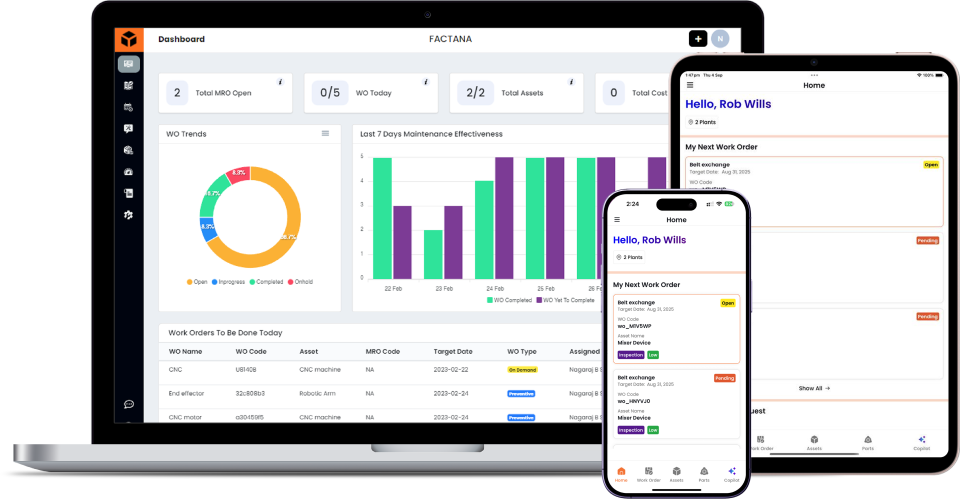
If aligned with SMRP:
- Advanced work order management ensures tasks are planned, scheduled, and tracked efficiently.
- KPI dashboards provide visibility into performance metrics such as MTBF, MTTR, and backlog
- Cost tracking enables financial control and optimization.
- Asset hierarchy and criticality models support strategic decision-making.
If aligned with TPM:
- OEE tracking provides real-time visibility into equipment performance
- Autonomous maintenance checklists empower operators via mobile interfaces.
- Minor stop tracking captures hidden losses often ignored in traditional systems.
- Kaizen workflows enable continuous improvement and knowledge sharing.
Strategic Recommendation
Relying exclusively on one approach creates structural gaps:
- Only SMRP → Strong governance but limited engagement at the shopfloor
- Only TPM → Strong engagement but weak standardization and scalability
The most effective organizations adopt a layered strategy:
- TPM at the operational level to eliminate losses and improve equipment effectiveness
- SMRP at the management level to standardize processes and measure performance
- CMMS is the digital backbone that integrates both seamlessly
Conclusion
Maintenance excellence today requires more than tools and processes; it demands a balanced integration of people, processes, and technology.
Organizations that succeed are those that:
- Empower their workforce
- Standardize their operations
- Measure performance rigorously
- Continuously improve through data and insights.
In an era defined by Industrial AI and connected assets, the convergence of TPM and SMRP is not optional—it is the foundation for building resilient, efficient, and future-ready maintenance organizations.
FAQs
1. What is the main difference between SMRP and TPM?
The main difference in SMRP vs TPM lies in their approach—SMRP focuses on structured maintenance management and KPIs, while TPM focuses on shopfloor engagement and eliminating equipment losses.
2. Which approach is better for maintenance teams?
There is no single best approach. SMRP helps with standardisation and control, whereas TPM improves daily operations and equipment efficiency. Most organisations benefit from combining both.
3. Can SMRP and TPM be used together?
Yes, many organisations adopt a hybrid approach using TPM at the operational level and SMRP at the management level to ensure both efficiency and scalability.
4. How does a CMMS support SMRP vs TPM strategies?
A CMMS plays a critical role in SMRP vs TPM implementation by enabling KPI tracking, work order management, and cost control (SMRP), along with real-time monitoring, OEE tracking, and operator-driven maintenance (TPM).
5. Which industries commonly use these maintenance approaches?
TPM is widely used in manufacturing sectors like automotive and FMCG, while SMRP is more common in asset-intensive industries such as oil & gas, power generation, and utilities.