
Facility Maintenance Management goes beyond everyday repairs in today’s demand. It involves proactive planning, real-time execution, tracking, regulatory compliance, workforce coordination, asset health visibility, and continuous performance optimization.
With growing operational complexity, facility managers must focus on smart, structured, and data-driven approaches to keep operations running without interruption.
The following sections cover the top 10 best practices for facility maintenance management.
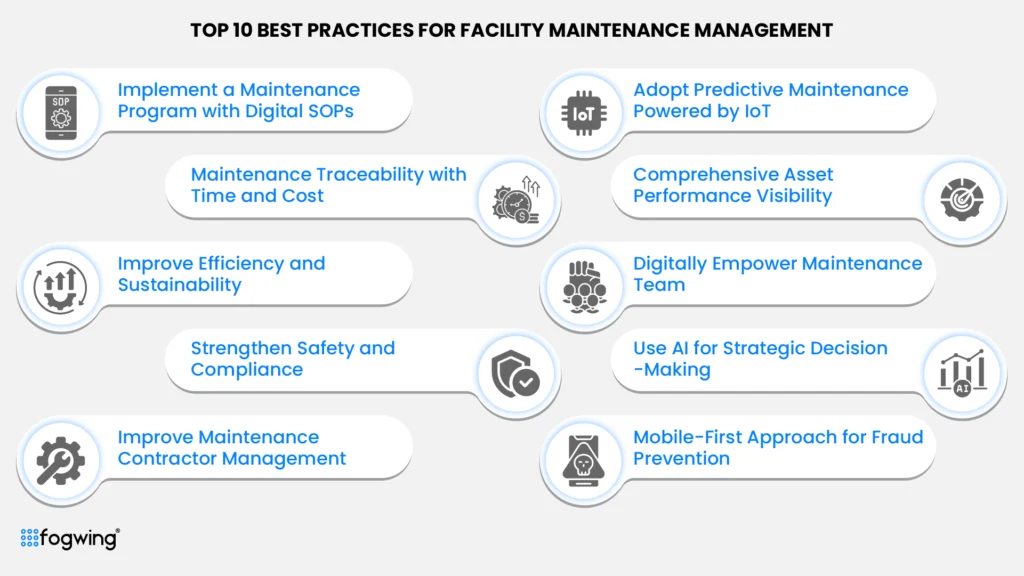
1. Implement a Maintenance Program with Digital SOPs
Preventive Maintenance (PM) is the most foundational strategy in Facility Maintenance Management. It involves performing scheduled tasks before issues arise, ensuring assets operate at peak efficiency.
Facility maintenance management includes critical assets such as HVAC, electrical panels, generators, elevators, fire safety systems, water pumps, boilers, etc. A failure in any of these directly impacts occupant comfort, safety, and business continuity.
A preventive approach reduces emergency breakdowns, lowers repair costs, and extends equipment life. This makes preventive maintenance one of the most essential best practices for facility maintenance management, especially for facilities managing numerous critical assets
How to apply the preventive maintenance with SOPs?
- Create a complete list of assets requiring Preventive Maintenance (PM).
- Identify PM intervals required for better service (daily, weekly, monthly, quarterly, etc.)
- Link each maintenance work order with Digital SOPs to guide technicians step-by-step.
- Use standardized digital checklists for consistency across assets.
- Track time and cost associated with each PM task
Preventive maintenance ensures that facilities remain compliant, comfortable, and safe for occupants while reducing the facility team’s reactive workload.
2. Adopt Predictive Maintenance Powered by IoT
Predictive Maintenance (PdM) takes maintenance to a higher level by using real-time data to detect equipment abnormalities and predict failures before they occur.
Unlike traditional preventive maintenance, which enforces maintenance activities regardless of asset conditions, predictive maintenance allows for detecting asset conditions and health parameters in real-time using sensors and IoT to trigger maintenance work.
How to apply Predictive Maintenance?
Facilities house mission-critical systems, such as chillers, UPS units, compressors, and HVAC units, which can degrade over time or be impacted by certain environmental changes.
IoT-based condition monitoring helps detect issues like vibration anomalies, overheating, or abnormal energy consumption in advance.
Best Practice for Predictive Maintenance
- Install IoT sensors to capture health parameters of assets.
- Maybe monitoring vibration, temperature, humidity, pressure, or electrical load helps to determine the conditions.
- Analyze trend deviations to identify early-stage failures.
- Automate maintenance work orders based on the alerts, before downtime occurs.
Predictive insights improve uptime, prevent major failures, and minimize disruptions to building operations. This elevates facility reliability, reduces maintenance expenditure significantly, and forms a key part of the modern best practices for facility maintenance management .
3. Maintenance Traceability with Time and Cost
Work orders are the core operational documents within facility maintenance. Standardizing them ensures smooth workflows, faster response, and better coordination.
This level of structure aligns closely with the best practices for facility maintenance management, ensuring that every taskfrom fixing lighting issues to servicing HVAC units is traceable, accountable, and efficiently executed. Without structured work orders and proper traceability, tasks can be delayed, miscommunicated, or carried out incorrectly, leading to higher operational expenses
How to apply Maintenance Traceability?
- Centralize work order requests from tenants, staff, or supervisors.
- Assign work order based on technician expertise and availability.
- Capture labor time spent for each work order for accurate workforce utilization.
- Record costs against each work order for budget optimization
- Use digital documentation (photos, notes, and video evidence)
Standardized work orders eliminate confusion, establish accountability, and improve team coordination, making daily facility operations smoother and more predictable.If you’re evaluating maintenance systems, understanding the differences between CMMS, FMS, and FSM can help you choose the right platform
4. Comprehensive Asset Performance Visibility
Asset performance is the backbone of efficient Facility Maintenance Management and plays a major role in achieving the best practices for facility maintenance management. A complete visibility of the asset 360 view helps maintenance leaders understand what they own, where assets are located, how the assets perform, and in what condition they operate.
Larger facility maintenance requires hundreds or thousands of assets, each with unique maintenance needs. An incomplete asset inventory and operational visibility lead to poor planning and unexpected failures.
How to get asset performance visibility?
- Maintain digital records of each asset.
- Include details like age, specifications, warranty, vendor, model, and serial number.
- Track MTBF (Mean Time Between Failures) for reliability insight
- Track MTTR (Mean Time To Repair) for workforce efficiency
- Monitor downtime history and health score trends.
An accurate asset inventory gives managers visibility into asset health, lifecycle status, compliance readiness, and long-term investment needs, making it one of the foundational best practices for facility maintenance management.
5. Improve Efficiency and Sustainability
The energy consumption of each asset accounts for a significant portion of asset performance and operational expenses in commercial and industrial facilities. This makes energy-efficient operations a vital part of the best practices for facility maintenance management in modern buildings
Every facility manager must adopt to track the energy and operational cost of each critical asset, such as HVAC systems, UPS systems, and other utilities required to run efficiently. Higher energy consumption is often considered a waste, signaling deeper maintenance problems like component wear or airflow blockages.
How to improve efficiency and sustainability?
- Continuously monitor asset performance, energy, water, and environmental usage using IoT.
- Identify inefficiencies through consumption patterns and performance metrics.
- Link energy spikes to maintenance anomalies and trigger a maintenance work order.
- Perform routine inspections of HVAC and power distribution systems.
- Implement smart automation for lighting and ventilation.
Asset’s energy-efficient operations reduce operational costs, ensure healthy indoor environments, and support sustainability requirements.
6. Digitally Empower Maintenance Team
A highly reliable maintenance workforce directly influences operational excellence, aligning closely with the best practices for facility maintenance management. In order to get maximum efficiency and performance, technicians must be empowered by digital tools and data access systems to streamline maintenance efficiency and process performance.
In most cases, the maintenance team often works across multiple floors, buildings, or dispersed remote facilities. Without mobile access to tasks, asset details, and instructions, technicians may be limited to maintenance tasks, which will result in higher asset downtime and efficiency drops.
How to implement digital practice in maintenance operations?
- Equip technicians with mobile access to maintenance tasks.
- Provide interactive digital SOPs for each procedure.
- Train technicians in IoT systems and digital inspections
- Maintain a digital knowledge base of manuals, diagrams, and troubleshooting guides.
- Enable real-time communication between field techs and supervisors.
A digitally empowered workforce executes tasks faster, more accurately, and more consistently—reducing repeat work and improving safety.
7. Strengthen Safety and Compliance
Safety and compliance are essential responsibilities for facility operations. Improper execution or documentation may lead to regulatory violations, fines, or operational shutdowns.
Maintenance tasks directly impact fire safety, electrical safety, water quality, indoor air quality, and emergency preparedness, all critical compliance areas.
How to enforce safety and compliance practices?
- Implement digital safety checklists for fire systems, lifts, generators, etc.
- Maintain scheduled compliance inspections.
- Record incidents, hazards, and corrective actions digitally
- Archive safety reports for audit readiness
- Ensure Digital SOPs include safety steps in every maintenance task.
Digitizing safety workflows ensures facilities remain compliant, safe for occupants, and fully audit-ready at all times, reflecting one of the critical best practices for facility maintenance management
8. Use AI for Strategic Decision-Making
Artificial Intelligence transforms raw maintenance data into actionable insights, supporting the best practices for facility maintenance management through smarter, predictive, and automated decision-making It also helps facility managers understand asset performance, operational patterns, simplify the digital adoption across the maintenance team, and optimize future planning.
Advanced AI solution, such as Generative AI, Video Analysis, Image Analysis, and Voice Analysis, helps to simplify operations, provide insights, guide decisions on repairs, replacements, technician performance, and even budget allocation.
How to adopt advanced AI in maintenance operations?
- Adopt AI-first CMMS software such as Fogwing CMMS to quickly adopt AI assistance.
- Evaluate IoT-based asset reliability with MTBF and health trends.
- Monitor technician performance and task completion through Mobile CMMS.
- Generate a work summary using Generative AI for compliance filing.
- Capture all maintenance data evidence as Sound, Video, Image, and Voice recordings.
With analytics, facility leaders move from reactive “firefighting” to proactive, strategic planning— improving long-term asset reliability and financial control.
9. Improve Maintenance Contractor Management
Many facility operations rely on outsourced contractors for HVAC servicing, electrical work, sanitary maintenance, calibration, landscaping, and emergency repairs. Without proper oversight, vendor activities may lead to incorrect repairs, inflated billing, or missing documentation.
How to streamline AMC/CMC contracts?
- Record each vendor contract document, contract terms, SLA, and work efforts digitally.
- Track SLA adherence, service times, and costs of operations
- Maintain documentation such as agreements and work orders.
- Validate parts usage during contractor maintenance to prevent fraud.
- Evaluate vendor performance periodically.
Digital vendor management ensures service consistency, cost accuracy, and reliability of outsourced activities.
10. Mobile-First Approach for Fraud Prevention
Digitization creates transparency, accountability, and real-time visibility—critical for modern facility operations. Paper-based workflows slow down operations and introduce risk.
Digitized operations eliminate delays, improve accuracy, and ensure every task, asset, and cost is properly documented.
How to adopt a mobile-first approach?
- Digitize asset data, work orders, inspections, and logs using Fogwing CMMS
- Use Fogwing CMMS mobile access for technicians and supervisors.
- Implement real-time notifications for critical events.
- Track inventory with barcode/QR scanning.
- Monitor parts usage to prevent theft, misuse, and fraud.
- Maintain complete audit trails for every action.
Digitization connects people, assets, and processes—creating a unified, transparent, and efficient maintenance ecosystem.
How Fogwing CMMS Modernizes Facility Maintenance Management?
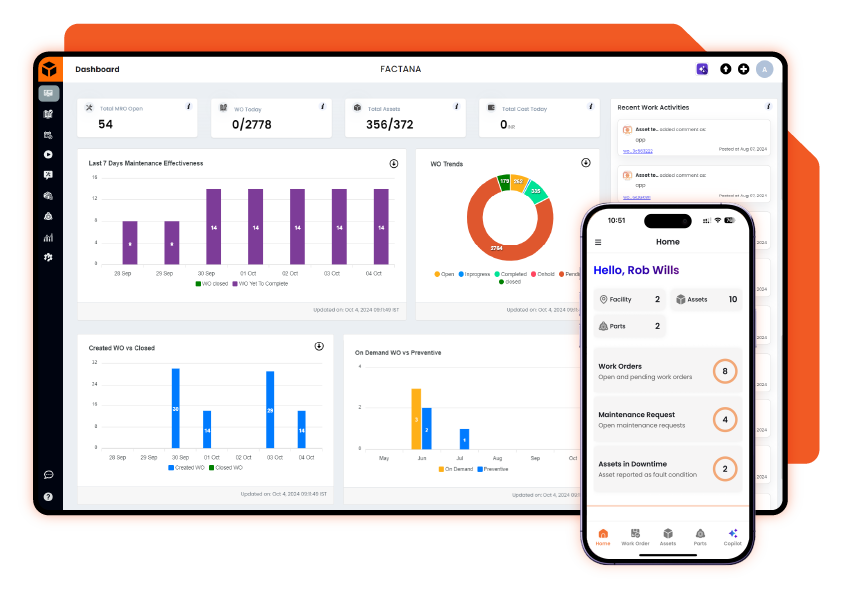
Fogwing Operations Management Platform offers a complete Fogwing CMMS Suite designed for modern facilities. Fogwing CMMS stands out as an advanced, integrated platform that unifies asset management, maintenance workflows, mobility, analytics, and IoT-driven insights, empowering facility teams to run fully digital, automated, and performance-driven operations with exceptional accuracy and efficiency.
- Fogwing CMMS for managing work orders and maintenance
- Fogwing CMMS for Asset inventory and lifecycle management
- Fogwing CMMS provides Digital SOPs and inspection checklists.
- Fogwing Mobile-first CMMS empowers technician workflows.
- Fogwing CMMS allows tracking of maintenance time and cost.
- Fogwing CMMS allows for Inventory and spare parts audit trails.
- IoT-based Fogwing CMMS enables asset condition-based maintenance operations.
- Fogwing CMMS provides Asset 360 performance analytics.
- Fogwing Asset Performance Management offers Predictive maintenance capabilities.
Fogwing enables facility managers to operate with full visibility, smarter decision-making, predictive insights, and digital efficiency.

Conclusion: Facility Maintenance Management Is Evolving Fast
acility maintenance today demands a proactive, mobile-first, and intelligence-driven approach built on proven Best Practices for Facility Maintenance Management. This enables teams to stay connected, respond faster, and make smarter decisions
By adopting these ten best practices, organizations can significantly enhance their maintenance ecosystem, resulting in higher asset reliability, faster task resolution, and consistently accurate documentation across all activities.
These strategies also help reduce downtime and operational costs, provide clear visibility into vendor performance, improve energy efficiency, and strengthen compliance with regulatory standards.
Frequently Asked Questions (FAQs)
1. What are the most important strategies in facility maintenance management?
Together, these strategies form the foundation of today’s best practices for facility maintenance management. They include preventive maintenance planning, predictive monitoring, mobile-first work order execution, digital SOP standardisation, energy efficiency management, performance analytics, and strong vendor and inventory control.
Collectively, these practices reduce downtime, improve asset longevity, and streamline maintenance operations.
2. How does a mobile-first approach improve facility maintenance efficiency?
A mobile-first approach empowers technicians to receive work orders, update task status, capture photos, access SOPs, and track time and parts usage directly from their mobile devices. This reduces delays, ensures real-time documentation, and improves responsiveness, especially in large or multi-building facilities.
3. Why is digital SOP important in facility maintenance management?
Digital Standard Operating Procedures (SOPs) ensure uniformity, accuracy, and compliance in every maintenance task. They guide technicians step-by-step, reduce human error, improve safety, and help maintain consistent service quality across teams, contractors, and shifts.
4. How does performance tracking help optimize facility operations?
Performance tracking through asset dashboards and KPIs helps maintenance leaders monitor equipment reliability, identify recurring issues, track technician productivity, measure energy performance, and make data-driven decisions. This allows facilities to prioritize critical assets, improve planning, and reduce operational costs.
5. What role does a CMMS play in implementing these best practices?
A CMMS centralizes all maintenance activities including scheduling, work orders, asset history, inventory tracking, vendor records, and cost reporting into a single digital platform. It enables preventive, predictive, and corrective maintenance to be executed more efficiently. Advanced CMMS solutions like Fogwing CMMS also integrate mobility, automation, and analytics to help organizations run fully digital, high-performance facility operations.