
With a Practical Maintenance Checklist for Food Manufacturing Plants
The food manufacturing plants operate in highly demanding production environments where equipment reliability, hygiene, and production efficiency must work in tandem. Manufacturing food products typically follows the continuous process methodology, where a small equipment failure can not only cause production downtime but may also result in food safety risks, contamination, or regulatory non-compliance.
Due to this high risk, food manufacturers must implement structured maintenance management practices that ensure equipment operates safely, efficiently, and consistently.
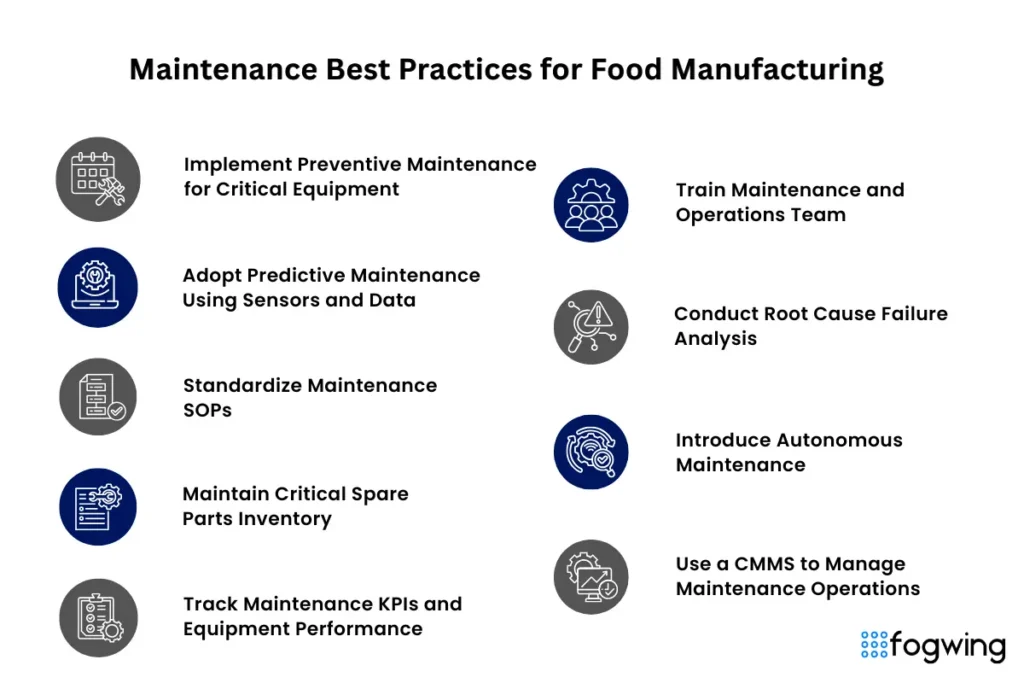
Maintenance Best Practices for Food Manufacturing
We will explore the top Maintenance Best Practices for Food Manufacturing and provide a practical maintenance checklist for food processing plants.
1. Implement Preventive Maintenance for Critical Equipment
Preventive maintenance is the foundation of an effective maintenance strategy in food manufacturing.
Instead of reacting when machines fail, maintenance teams must perform scheduled maintenance such as inspections, corrective, calibration, and component replacements to prevent unexpected breakdowns during production hours.
Some of the critical equipment that typically requires preventive maintenance include:
- Mixers and grinders
- Conveyors
- Packaging machines
- Refrigeration systems
- Ovens and dryers
Preventive maintenance improves equipment lifespan, production stability, and operational safety.
2. Adopt Predictive Maintenance Using Sensors and Data
In addition to preventive maintenance for critical equipment, modern sensor-based technology enables the implementation of maintenance work based on equipment conditions, known as predictive maintenance. This approach helps maintenance teams detect equipment issues before they cause failures.
Some of the common equipment condition monitoring techniques using sensors:
- Motor vibration analysis
- Temperature fluctuations
- Energy consumptions and fluctuations
- Oil level, pressure, and flow monitoring
Modern AI platforms such as Fogwing CMMS help to analyze this data, predict unusual conditions of the component wear, and automatically schedule repairs proactively, minimizing downtime.
This approach is increasingly adopted in modern smart food factories using an IoT-enabled Fogwing CMMS platform.
3. Standardize Maintenance SOPs
Maintenance checklists and Standard Operating Procedures (SOPs) play a critical role in ensuring that maintenance tasks are performed correctly, on time, and in compliance with food safety regulations.
A maintenance checklist and SOP provide a structured list of inspection and servicing tasks that technicians or operators must perform during routine maintenance activities.
These checklists help ensure that no critical maintenance step is missed during inspections, cleaning, lubrication, or equipment adjustments.
By following a checklist, maintenance teams can maintain consistency across shifts, improve accountability, and detect potential equipment issues early before they escalate into failures.
Some of the common checklists and procedures that every critical asset maintenance should follow are:
- Inspection Checklist
- Cleaning Procedure
- Lubrication Checklist
- Calibration Checklist
- Repair or Replacement Procedures
Well-defined SOPs help reduce maintenance errors and improve technician efficiency.
Fogwing CMMS provides a digital checklist feature to allow the maintenance team to keep track of the checklist compliance without carrying any paper-based checklists.

4. Maintain Critical Spare Parts Inventory
Typical Food production plants rely on equipment such as mixers, grinders, boilers, and packing machines, which have many mechanical and electrical components. If critical spare parts are unavailable during corrective maintenance or any breakdowns, it can lead to loss of production capacities, raw materials wastage, and financial impacts.
At the same time, manually maintaining spare parts inventory in ledgers will lead to confusion and overstock, requiring higher CAPEX.
It is important that maintenance teams accurately track the parts availability, usage, and refill as and when required.
- Identify critical spare parts for production lines.
- Maintain minimum stock levels.
- Track spare parts consumption
- Automate reorder alerts
Digitalizing the parts inventory and tracking the usage according to the maintenance schedule will help to ensure quick equipment restoration during failures.
5. Track Maintenance KPIs and Equipment Performance
The most important process in the maintenance operations is not just about doing repeated maintenance to prevent downtime, but also measuring the process compliance for continuous improvement.
Maintenance teams should continuously monitor key performance indicators (KPIs) to improve maintenance strategies.
Important maintenance KPIs include:
- Mean Time Between Failures (MTBF)
- Mean Time To Repair (MTTR)
- Equipment downtime
- Maintenance cost per asset
- Overall Equipment Effectiveness (OEE)
These metrics help plant managers make data-driven maintenance decisions.
6. Train Maintenance and Operations Team
Maintenance efficiency depends heavily on skilled technicians and knowledgeable operators.
In today’s competitive world, hiring qualified engineers for maintenance operations is highly challenging. Also, the senior members of the maintenance team are in search of new opportunities or retirement. Traditional maintenance operations do not force these challenges, so retaining the team members is the only way to retain knowledge.
In the digital maintenance operations, all knowledge and history about equipment is tracked within the system, so providing training to new members and retaining the knowledge is simplified.
Digital Maintenance programs should cover the following training:
- Equipment operating principles
- Maintenance procedures
- Safety guidelines
- Food hygiene practices
Proper training ensures faster troubleshooting and safer maintenance operations.
7. Conduct Root Cause Failure Analysis
One of the critical Maintenance Best Practices for Food Manufacturing is to control repeated machine breakdowns by conducting root cause failure analysis (RCFA) for repeated faults.
The best way to track the issues is by clearly declaring all faults as master data and recording each incident against the fault to find the repeated issues.
Common analysis methods include:
- 5 Whys analysis
- Fishbone diagram
- Failure Mode and Effects Analysis (FMEA)
This helps identify the true cause of failures and prevents recurring problems. Fogwing CMMS provides an AI-Powered RCA feature, which helps to complete the analysis faster, easier, and more accurately.
8. Introduce Autonomous Maintenance
Autonomous maintenance is a concept from Total Productive Maintenance (TPM) where machine operators perform basic maintenance activities without involving the maintenance team.
However, these maintenance activities must be tracked with a system such as Fogwing CMMS for historic data collection and lateral analysis.
Operators typically perform:
- Equipment cleaning
- Visual inspection
- Basic lubrication
- Reporting abnormalities
This allows maintenance teams to focus on more complex repairs and reliability improvements. This approach helps to handle a large number of equipment maintenance tasks with a limited team.
9. Use a CMMS to Manage Maintenance Operations
All the above best practices require a systematic approach and accurate planning to achieve the best results. It is impractical to manually plan or track (either in an Excel sheet or on a whiteboard). A Computerized Maintenance Management System (CMMS) allows maintenance teams to manage all these maintenance best practices digitally.
Fogwing CMMS is the best software application to digitalize maintenance operations without a long implementation.
With a Fogwing CMMS, organizations can:
- Schedule preventive maintenance tasks.
- Track work orders and technician activities
- Maintain equipment maintenance history.
- Manage spare parts inventory.
- Analyze maintenance performance
Fogwing CMMS helps to improve maintenance planning, team coordination, and asset visibility across the plant.

Maintenance Checklist for Food Production Plants
Below is a practical maintenance checklist that food processing plants can follow to maintain equipment reliability and hygiene standards.
Daily Maintenance Checklist
- Inspect conveyors for debris or product buildup.
- Check machine guards and safety devices.
- Verify lubrication levels in motors and bearings.
- Clean food-contact surfaces
- Inspect air compressors and pneumatic lines.
- Check for abnormal noise or vibration in machines.
- Verify temperature and pressure readings.
Weekly Maintenance Checklist
- Inspect belts, chains, and pulleys.
- Check electrical connections and control panels.
- Inspect seals and gaskets for leaks.
- Verify calibration of sensors and gauges.
- Inspect cooling and refrigeration systems.
- Check hydraulic and pneumatic systems.
Monthly Maintenance Checklist
- Perform a detailed inspection of motors and gearboxes.
- Verify alignment of rotating equipment.
- Inspect safety systems and emergency stops.
- Review maintenance logs and work orders.
- Conduct vibration and thermal analysis where applicable.
- Inspect spare parts inventory levels.
Quarterly / Annual Maintenance Checklist
- Replace worn-out mechanical components.
- Perform deep cleaning of processing equipment.
- Inspect the structural integrity of machines.
- Conduct equipment calibration and validation
- Evaluate equipment performance and maintenance KPIs
Conclusion
Maintenance management in food manufacturing is not just about fixing equipment and running. It is about ensuring consistent product quality, operational reliability, and food safety compliance.
By adopting structured maintenance practices such as:
- Preventive maintenance
- Predictive monitoring
- CMMS-based maintenance planning
- Autonomous maintenance
- Root cause analysis
Food manufacturers can significantly reduce downtime, improve equipment performance, and maintain regulatory compliance.
A well-implemented maintenance program ultimately improves plant productivity while protecting product quality and consumer safety.
FAQs on Maintenance Best Practices for Food Manufacturing
1. What are the key maintenance best practices for food manufacturing plants?
The most effective maintenance best practices for food manufacturing include preventive maintenance, predictive monitoring, standardised SOPs, spare parts management, and KPI tracking. Together, these ensure equipment reliability, food safety, and smooth production.
2. Why are maintenance best practices for food manufacturing important?
They help prevent unexpected breakdowns, reduce contamination risks, and ensure compliance with food safety regulations. Following the right maintenance approach also improves productivity and lowers overall operational costs.
3. How does predictive maintenance improve food manufacturing operations?
Predictive maintenance uses real-time data such as vibration, temperature, and energy usage to identify issues early. This allows teams to fix problems before failures occur, reducing downtime and improving efficiency.
4. Why are SOPs and maintenance checklists essential in food plants?
SOPs and checklists ensure maintenance tasks are carried out consistently and correctly. They help maintain hygiene standards, reduce errors, and ensure compliance with food safety requirements.
5. Why should food manufacturers use CMMS software for maintenance?
A CMMS helps streamline maintenance by scheduling tasks, tracking work orders, managing spare parts, and analysing performance. It improves visibility, planning, and overall equipment reliability.