

Why Downtime Is a Critical Challenge for Manufacturers
Downtime in Manufacturing is one of the most expensive and underestimated challenges faced by industrial organizations, especially in the highly competitive manufacturing ecosystem. To stay competitive and profitable, manufacturers must actively Reduce Downtime in Manufacturing by adopting proactive, data-driven maintenance and operational practices.
From automotive and electronics to food processing, pharmaceuticals, and heavy engineering, unplanned downtime has a direct impact on production output, delivery commitments, operational costs, and customer trust.
In fast-growing APAC, manufacturers are under constant pressure to:
- Produce more with fewer resources.
- Meet strict quality and compliance standards.
- Control rising labor and energy costs
- Maintain high equipment availability.
Yet many plants still rely on reactive maintenance practices, spreadsheets, or disconnected legacy systems.
This article explores how to reduce downtime with CMMS, combining proven maintenance strategies, real-world manufacturing use cases, and best practices tailored for APAC manufacturers.
Understanding Downtime in Manufacturing
Downtime in Manufacturing refers to periods when equipment, machines, or production lines are not operational due to failures, maintenance activities, or external factors. Downtime can be broadly classified into:
Planned Downtime :
- Preventive maintenance
- Scheduled inspections
- Equipment upgrades
Unplanned Downtime :
- Equipment breakdowns
- Power failures
- Operator errors
- Spare part shortages
While planned downtime is controlled and strategic, unplanned downtime is costly and disruptive.
For APAC manufacturers, downtime costs go beyond machine repair:
- Lost production hours
- Missed delivery deadlines
- Overtime labor costs
- Increased scrap and rework
- Reduced equipment lifespan
- Compliance risks (especially in pharma and food)
Studies show that unplanned downtime can cost manufacturing plants up to 5–20% of their total productive capacity annually. For high-volume plants, this translates into millions in lost revenue.
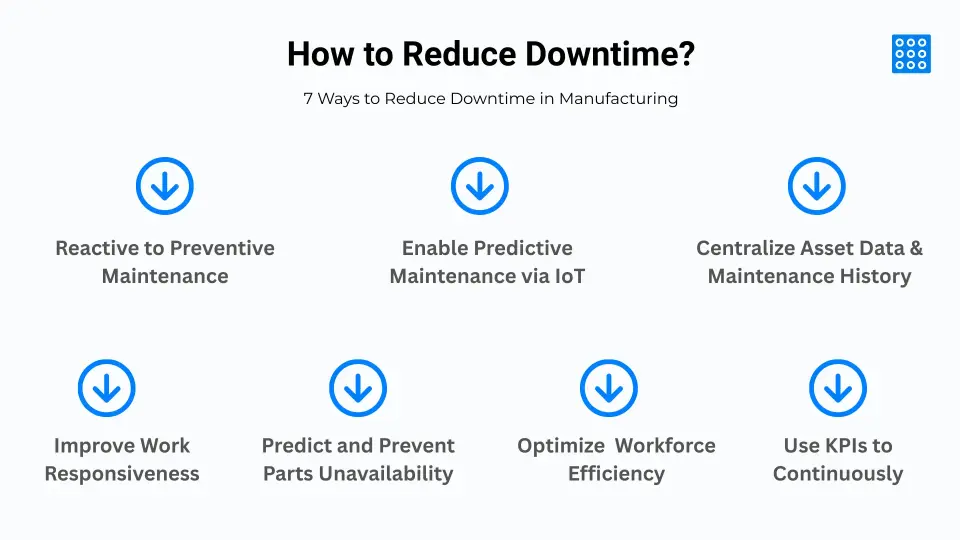
7 Ways to Reduce Downtime in Manufacturing
Reducing Downtime is no longer about working harder; it is about working smarter, data-driven, and proactive practice. Modern CMMS software acts as the digital backbone that connects assets, people, processes, and performance.
When implemented strategically, CMMS software can transform maintenance from a cost center into a business value driver, enabling manufacturers to compete effectively in the demanding APAC market.
1. Shift from Reactive to Preventive Maintenance
In many manufacturing plants, machine breakdown occurs regardless of the high maintenance efforts. This unorganized approach may seem cost-effective in the short term, but it significantly increases unplanned downtime, emergency labor costs, and asset deterioration.
Machines are pushed beyond safe operating limits, and maintenance teams are forced into firefighting mode rather than value-driven planning.
A CMMS fundamentally changes this model by enabling structured Preventive Maintenance (PM). Instead of relying on individual experience or manual reminders, CMMS schedules maintenance activities based on:
- Time intervals (daily, weekly, monthly)
- Production cycles or runtime hours
- OEM-recommended service intervals
By automating preventive maintenance schedules, CMMS ensures that critical inspections, lubrication, calibration, and part replacements are never skipped. This reduces wear-and-tear-related failures and stabilizes production schedules.
Strategically, preventive maintenance through CMMS allows manufacturers to:
- Plan maintenance during low-production windows
- Balance maintenance workload across shifts
- Reduce dependency on emergency repairs.
This proactive shift is the foundation of how to reduce downtime with CMMS, especially for plants operating under cost pressure and high production variability common in the APAC region.
2. Enable Predictive Maintenance Through Asset Condition Monitoring
While preventive maintenance improves reliability, it can still lead to over-maintenance or unnecessary stoppages. This is where CMMS evolves into a predictive maintenance enabler.
Modern CMMS platforms integrate seamlessly with:
- IoT sensors
- PLC and SCADA systems
- Energy meters and vibration sensors
By continuously collecting real-time asset condition data, CMMS helps identify early warning signs of failure, such as abnormal vibration, temperature spikes, pressure deviations, or energy inefficiencies.
Instead of asking “When was the last service done?”, maintenance teams can now ask “What is the current health of this asset?”.
From a strategic standpoint, predictive maintenance:
- Prevents catastrophic equipment failures
- Reduces sudden line stoppages
- Extends asset life for capital-intensive machines
- Aligns maintenance decisions with actual asset behavior
For APAC manufacturers operating high-speed lines, CNC machines, compressors, boilers, and utilities, predictive maintenance is a competitive differentiator and a critical component of how to reduce downtime with CMMS.
3. Centralize Asset History for Faster Data Access
One of the most common contributors to prolonged downtime is slow and inaccurate problem diagnosis. When machines fail repeatedly, teams often rely on memory, handwritten logs, or scattered spreadsheets to understand past issues—leading to trial-and-error repairs.
CMMS eliminates this inefficiency by creating a single source of truth for asset history. Every asset record contains:
- Breakdown and failure history
- Maintenance actions performed
- Parts replaced and frequency.
- Technician observations and corrective actions
- Performance trends such as MTBF and MTTR
This historical intelligence allows maintenance engineers to perform data-driven root cause analysis (RCA) instead of assumptions.
Strategically, asset history in CMMS helps organizations:
- Identify chronic problem assets.
- Eliminate recurring failure patterns.
- Improve design, operating, or maintenance practices.
- Retain institutional knowledge despite technician attrition.
By reducing diagnostic time and improving fix accuracy, centralized asset intelligence plays a direct role in reducing downtime with CMMS.
4. Improve Work Order Management and Responsiveness
In many manufacturing plants, downtime is prolonged not because of technical complexity but due to poor coordination between team and delayed response. Maintenance requests may be verbal, undocumented, or lost between shifts, leading to confusion and idle machines.
CMMS introduces structured and transparent work order management, ensuring that every maintenance activity is:
- Digitally logged
- Time-stamped
- Prioritized based on asset criticality
- Assigned to the right technician
- Tracked until closure
This structured workflow significantly reduces response time during breakdowns and improves communication between production and maintenance teams.
From a strategic perspective, CMMS-driven work order management:
- Improves maintenance SLA adherence
- Prevents duplication of work
- Enhances accountability and traceability
- Enables accurate downtime attribution
For APAC manufacturers running multi-shift operations, faster response time directly translates into higher line availability, making work order optimization a key pillar of how to reduce downtime with CMMS.
5. Reduce Downtime Caused by Parts Unavailability
A surprisingly high percentage of downtime in manufacturing plants occurs after the problem is identified, simply because the required spare part is unavailable. This issue is especially common in APAC regions where supply chains may be long, fragmented, or import dependent.
CMMS integrates spare parts and inventory management directly with maintenance operations. Each asset is linked to:
- Recommended spare parts
- Historical consumption data
- Minimum and reorder stock levels
When a work order is raised, CMMS instantly checks spare availability, ensuring maintenance teams are not caught unprepared.
Strategically, CMMS-based inventory control helps manufacturers:
- Avoid emergency procurement
- Reduce excess inventory carrying costs.
- Improve supplier planning
- Shorten repair cycle time.
Ensuring spare parts readiness is a silent but powerful lever in the broader strategy of how to reduce downtime with CMMS.
6. Optimize Maintenance Workforce Efficiency
In many APAC manufacturing environments, skilled maintenance technicians are limited, and plants rely heavily on a few senior experts. When these individuals are unavailable, downtime increases due to delayed diagnosis or incorrect repairs.
CMMS improves workforce efficiency by:
- Assigning tasks based on technician skill, certification, and availability
- Providing digital SOPs, manuals, and checklists at the point of work
- Capturing technician feedback for continuous improvement
This not only improves first-time fix rates but also accelerates the skill development of junior technicians.
From a strategic viewpoint, CMMS enables:
- Standardized maintenance execution across shifts and plants
- Reduced dependency on individuals
- Scalable maintenance operations during plant expansion
Optimized technician utilization ensures that downtime reduction is sustainable, not dependent on heroics, an essential factor in how to reduce downtime with CMMS.
7. Use KPIs to Continuously Reduce Downtime
Downtime reduction is not a one-time initiative; it requires continuous monitoring and improvement. CMMS provides powerful analytics and KPIs that turn raw maintenance data into actionable insights.
Key metrics tracked through CMMS include:
- Downtime by asset, line, and cause
- Planned vs unplanned downtime ratio
- MTBF and MTTR trends
- Maintenance cost vs asset value
- Maintenance compliance rates
These insights help leadership teams make strategic decisions, such as:
- Identifying assets that need redesign or replacement
- Justifying CAPEX investments
- Aligning maintenance KPIs with production and business goals
For APAC manufacturers aiming for operational excellence and digital maturity, CMMS analytics close the loop in the journey of how to reduce downtime with CMMS.
Fogwing CMMS to Reduce Downtime upto 30%.
Fogwing CMMS helps manufacturing organizations reduce downtime by bringing asset visibility, maintenance intelligence, and operational control onto a single digital platform.
It enables maintenance teams to shift from reactive firefighting to planned, predictive, and data-driven maintenance by centralizing asset history, automating preventive maintenance schedules, and streamlining work order execution.
Key Fogwing CMMS capabilities include:
- Asset lifecycle management
- Preventive and predictive maintenance scheduling
- Real-time work order management
- Spare parts and inventory control
- Downtime tracking and root cause analysis
- Technician productivity tracking
- Compliance and audit readiness
Fogwing CMMS is ideal for APAC manufacturers because it combines enterprise-grade maintenance capabilities with cost-effective, easy-to-deploy technology.
Fogwing CMMS is a cloud-based, mobile-first design that supports multi-shift shop-floor operations and enables faster adoption across diverse workforce skill levels, with built-in preventive and predictive maintenance, real-time downtime analytics, and seamless integration with ERP and IoT systems.
Fogwing CMMS helps manufacturers improve asset reliability without complex implementation, making it a practical and scalable solution for the APAC manufacturing environment.

Fogwing CMMS Benefits Across Key Manufacturing Sectors
Fogwing CMMS can be implemented across various industries in manufacturing, facility management and field services. Some of the benefits across key manufacturing sectors are listed below.
Food & Beverage Manufacturing
- Compliance-ready maintenance records
- Reduced contamination risks
- Improved line availability during peak demand
Read this article to find the Best CMMS for Food & Beverage Manufacturing
Automotive & Auto Components
- High uptime for CNCs, presses, and assembly lines
- Predictable maintenance aligned with production schedules
Electronics & Semiconductor
- Precision equipment health monitoring
- Reduced micro-failure-induced downtime
Pharma & Life Sciences
- Audit-ready documentation
- Validated maintenance processes
- Reduced batch failures
Conclusion
In today’s competitive manufacturing environment, understanding how to reduce downtime with CMMS enables manufacturers to shift from reactive to predictive maintenance, improve asset reliability, lower operational costs, and build data-driven, resilient factories. A well-implemented CMMS is not just a maintenance tool, but a strategic enabler of sustainable manufacturing excellence.

FAQs
1. What is downtime in manufacturing?
Downtime in manufacturing refers to periods when machines, equipment, or production lines are not operational due to breakdowns, maintenance, power issues, or operational errors. It can be planned (scheduled maintenance) or unplanned (unexpected failures), with unplanned downtime having the highest cost impact.
2. Why is it important to Reduce Downtime in Manufacturing?
Manufacturers must Reduce Downtime in Manufacturing to protect production output, meet delivery commitments, and control rising operational costs. Even short periods of downtime can result in lost revenue, overtime labour, quality issues, and reduced customer trust
3. What are the main causes of downtime in manufacturing?
Common causes of downtime include:
- Equipment breakdowns
- Poor preventive maintenance
- Spare parts unavailability
- Operator errors
- Power or utility failures
- Lack of asset performance visibility
Addressing these root causes systematically is key to reducing downtime.
4. . How much can manufacturers realistically Reduce Downtime in Manufacturing using CMMS?
With proper implementation, manufacturers can typically Reduce Downtime in Manufacturing by 20–30%. Platforms like Fogwing CMMS achieve this by combining preventive maintenance, predictive insights, real-time analytics, and asset intelligence.